♔ Wachusett Chess Club Games ♔
♖ ♞ ♗ More games needed to make this section come to life! ♝ ♘ ♜
OK, here it is. For all those who are just itching to submit their games for publication or just get them into PGN format, this simple popup game editor allows you to do just that! When you click the PGN Editor Chess Tool you'll be treated to a popup chessboard that is easy to use & has enough features to generate game scores by moving the pieces just like you did in the actual game.
The easiest way if you don't already have a game file but would like to enter the game move by move is to:
* Select the second tab "2. Game Moves" button at the top of the popup window, then
* At this point you can make the moves of your game one by one in order, just as the game was played.
* Once you've entered all the moves, then click "NEXT" (again) &
* This will take you to the "3. Game Info" tab.
* Fill out the info so you & I both know who played the game & when & where, etc.
* Then click "NEXT" once more & your entire game appearas in the PGN box! (This I find pretty amazing!) The "4. Output" tab is highlighted.
* At this point, click on "SELECT PGN" (This will highlight the entire game.), then
* Put the mouse pointer into the PGN box & press CTRL-C
or press your RIGHT MOUSE BUTTON & select "COPY".
* Then open a text file on your computer or go to your email message window &
* Press CTRL-V or press the RIGHT MOUSE BUTTON & select "PASTE".
This should create a copy of your game in PGN format for saving as a file or emailing to someone like me.
Please email games to "mtal31 AT hotmail DOT com"[replace the "AT" & "DOT" letters with symbols & remove spaces in this to make a normal email address.] along with any notes or comments particularly about what you were thinking during the game. Believe it or not, this is phenomenally simple & if you go through it once or twice, you'll agree. The only thing I can imagine that would make the process easier for you to enter games would be extractive telepathy which I haven't quite figured out yet on my end, so I'm hoping lots of people try this & send in lots of games real soon.
Thanks for your continued enthusiastic participation.
2015 Games
Thanks to Walter Niemi for sending in these game scores.
{Almasi, Z (2717) vs. Korschnoj, V (2558), 1-0, Gibralter Masters 2012})
Here is the exciting draw that Walter Niemi achieved against his 193 point higher rated opponent, Roger Cappallo in the penultimate round of the Reggie Boon Memorial tournament. Included are comments based on annotations by two chess software programs, Chessbase 14 Database & Deep Fritz analysis engine.
FATV Chess Chat Games
This section contains the games featured on the FATV Chess Chat program in text & PDF versions.
They may also be viewed online here.
2014 Games
Thanks to Dave Thomas for submitting this game from the 2014 George Sturgis Memorial played last December:
Click here to view this game online.
0-1
Largely as a result of the concerted efforts of WCC Members, Arthur Barlas & Paul Godin, in both acquiring game score sheets & converting them into PGN format, the WCC Championship of 2014 is by far the best documented of any Club Championship ever held at the WCC. We should all hope this becomes standard & continues into the future so that others may view these important games.
Carissa Yip Games ♕
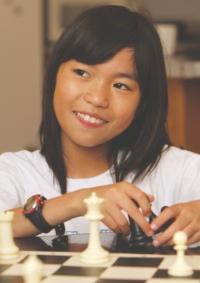
For the past few years now, Carissa Yip & her father Percy Yip have been regular members of the Wachusett Chess Club, beginning when she was barely eight years old. During that short span of about three years, Carissa has consistently improved her chess playing skill to such a degree that she has garnered national & international attention, typically as the youngest or youngest ever female to achieve certain notable milesrones such as USCF expert (2000+) rating in 2012 & her fourth place finish in the World Youth Chess Championships in 2013. Now her most recent accomplishment can be added to the list. That being the youngest female ever to attain a USCF master rating of 2200 or more. At the time of this writing (March 1st, 2015), her latest (now obsolete) title of "National Master", i.e. rating of 2200 or above, has not been officially confirmed by the USCF, but in all liklihood it soon will be. The USCF "Life Master" title requires that a player perform at or above master level in a number of tournaments & this is explained in the link above.
In addition to many weekly club games at the WCC in the last few years, including a 21 game uninterrupted winning streak culminating in her 7-0 perfect score at the 2014 WCC Championship, Carissa Yip has played in several national & international tournaments. Many of these games are significant both in terms of the overall quality of play & the relative importance of the events to the greater chess community. Due to the use of electronic recording chess boards, the majority of Carissa's international escapades have already found their way into a number of online databases. Here is a collection of a representative sample of those games for your study &/or enjoyment.
♔ Carissa Yip vs. GM Alexander Ivanov New England Open Leominster, MA, 2014.08.30
♕ 2014 US Girls' Invitational NH:
♕ 2013 chesskid.com Invitational:
♕ World Youth Chess Championship 2013 Dubai:
♕ World Youth Chess Championship 2012, Maribor, Slovenia:
- Al Muammari,Wafia - Yip,Carissa [C50](11) 2012.11.18
- Yip,Carissa - Du Toit,Stephanie (1588) [C50](10) 2012.11.17
- Lopez Sanchez,Anastacia (1391) - Yip,Carissa [E67](9) 2012.11.16
- Lopez Sanchez,Anastacia (1391) - Yip,Carissa [E67](Round 8) 2012.11.16 .pgn Format
- Mishra,Anwesha (1561) - Yip,Carissa [C44](7) 2012.11.14
- Yip,Carissa - Beshukova,Alina (1717) [B21](6) 2012.11.12
- Lichii,Elizaveta (1453) - Yip,Carissa [C92](5) 2012.11.12
- Yip,Carissa - Munkhzul,Turmunkh [C41](4) 2012.11.11
- Munoz,Clara Beren (1363) - Yip,Carissa [C54](3) 2012.11.10
- Yip,Carissa - Priyanka,N (1576) [B22](2) 2012.11.09
- Hrysogelou,Athanasia-Panagiot (1340) - Yip,Carissa [C54](1) 2012.11.08
♘ Carissa Yip vs. Gary Cote Mass Open U2000 Fitchburg, MA, 2012.05.26
♖ Carissa Yip vs. Ray Paulson Harlow B. Daly Memorial WCC(5) 2012.08.01
2013 Games
2012 Games
The above link connects to the online viewer for the six games submitted from the 21 games actually played in the 2012 WCC 2012 Championship.
2011 Games
2010 Games
Below is a game sent in by Rick Evans. This game was the biggest upset in recorded club history.
Wachusett Chess Club - Dec 1, 2010
White: Arthur Barlas, Elo: 1716
Black: Rick Evans, Elo: 879
1. e4 e6
Having been away from chess for many years, I resorted to my old favorite from the 1970s, the French Defense
4.e5 Nd7 5.Nf3 c5 6.c3 Nc6
So far, so much book.
I feared white playing Bd3 which seems more threatening especially if the white queen ends up on c2, but I probably also would play Be2 as white as it is very flexible. After Be2, I played cxd4 after weighing the alternative of c4, but I thought my better chances were to not lock up the queenside but try for a more open game there as I seemed to have lesser options on the kindside. I've seen masters lose in these positions after locking up the queenside in games on www.chessgames.com, so I had reservations about going that route.
8. cxd4 Be7 9. 0-0 0-0 10. Nb3 b6
I wasn't so sure about Nb3, but I suspected at the time that maybe Arthur thought that an 879 rated player might not think to really protect c5, but at any rate it adds protection to whites pawn on d4 and really isn't a bad move at all. I played b6 to allow b7 to my white bishop and to deny c5 and a5 to white's knight.
11. a3 f6
a3 denies b4 to my knight, but I had no plans whatever to post it there. I played f6 to try to break up white's formidable center, thinking that it was now or never.
12.Bb5 Bb7
I didn't like Bb 5 for white, but I'm not sure why; it seems plausible enough.
13. exf6 Bxf6
If I were white, I probably would not have taken the pawn as breaking up the center is black's problem and I would have probably just proceeded with what I wanted to accomplish.
14.Re1 Re8
Ah... so I begin to realize, black wants to make e6 a target, and a good one it is at that. Suddenly I see one of the problems of playing the French... this pawn formation that results in the center which can expose the e pawn to attack.
15.Bf4 a6
I thought the Bf4 was a great and strong move. I saw it coming. Oh well, nothing to do about it so I wanted to get rid of the other pesky bishop.
16. Bxc6 Bxc6
If I were white, I would not have been so quick to make this trade.
17.Qd2 Nf8
Oh my, white has really made my weak e6 pawn a target. What to do? It's really defensive but I just had to move the knight back to protect it.
18.Ne5 Bxe5
I expected Ne5 as it is strong and I had to give up my black bishop against my wishes. My only consolation was that I thought my knight on g6 would be helpful to me in driving away or exchanging white's now very annoying bishop on e5
19.Bxe5 Ng6 20.g3 Rc8
White, I presume, wanted to deny my knight f4 and h4 and wanted to give his king some space for the late middlegame, but I'm not so sure this would have been my choice if I were white.
21.h4 Ba4
I distinctly did not like h4 for white here. I would have played for dominance on the queenside instead. I played Ba4 to annoy the white knight. and demonstrate to white that I thought his kingside thoughts might be in error as far as I was concerned.
22.Qd3 Bb5 23.Qe3 Rc2
I whispered to Arthur that this might be my losing move and he replied something like, "...well either that or your winning move. Who knows?"
24.a4 Bd7 25.Re2 Rxe2
I didn't see any real alternative to exchanging rooks.
26.Qxe2 Nxe5
As we were almost entering an endgame like situation and I wasn't in fear of being mated or mating Arthur anytime soon, I thought it was a good idea to make this exchange.
27.Qxe5 Qb8
If I were white, I probably would have recaptured with the pawn, connecting my kingside pawns and proceeding with a blockade of the black pawn on d5. But who knows which plan is better at this point?
28.Qe2 a5
Well, I wanted to fix the temporarily vulnerable white pawn on A4. What can I say?
29.f4 Rc8
I see my only chance as activating my passive white bishop and getting my queen rook into the game in some meaningful way. The open c file seems attractive to me, as it has for a good part of the game. I'm wondering why white hasn't played to dominate it earlier.
30.Rc1 Qd6
Just trying to give my queen more scope.
31.Rxc8+ Bxc8 32.Qc2 Bd7
Got to protect those queenside invasion square religiously or all *&%$ will break lose on me.
33.Nc1 Qb4
I thought I gained some time here due to white's piece placement issues, and wanted to take full advantage.
34.b3 Qxd4+
Well, black's queen move came with more than one threat, and I won a pawn as it turned out. This is where the game sort of turns around in black's favor I think (or thought at the time)
35.Kh2 Qc5 36.Qxc5 bxc5
The rest of the game probably just demonstrates my lack of excellent endgame play, but the result was a win although surely not the most elegant one.
37.Nd3 c4
38.bxc4 dxc4
39.Ne5 c3
40.Nd3 Bxa4
41.Kg1 Kf7
42.Kf2 Kf6
43.g4 Bb3
44.Ke3 a4
45.Nc1 c2
46.Kd4 g6
47.Ke4 Bd5+
48.Ke3 h5
49.g5 Kf5
50.Ne2 Kg4
51.Kd2 Bb3
52.Nd4 Kxf5
53 White resigns.
0-1
These are the 6 games that Tony Cesolini played to win the 2010 Wachusett Chess Club Championship.
Tony Cesolini's 6 Championship Games
A very interesting game. There was a material imbalance for most of the game. Marty almost pulls out a draw, but blunders in time pressure.
In this game Gail Lingner of Fitchburg, returning to tournament chess after 17(!) years, defeated former club champion Martin Laine of Lunenburg.
[Event "2010 George O'Rourke Memorial"]
[Site "Fitchburg, MA"]
[Date "2010.02.17"]
[Round "1"]
[White "Martin Laine"]
[Black "Gail Lingner"]
[Result "0-1"]
[WhiteElo "1856"]
[BlackElo "1594"]
[TimeControl "G/110"]
In the notation below, the move in parenthesis is the move recommended by the computer program Rybka.
Bird's Opening
1. f4 Nf6
2. b3 e6
3. Bb2 Be7
4. Nf3 Nc6
5. e3 a6
6. Be2 b5
7. 0-0 0-0
8. Ne5 Bb7
9. Bf3 Rb8
10. d3 d5
11. g4 h6
12. g5 hxg5
13. fxg5? (Nxc6) Nxe5
14. Bxe5 Nd7
15. Bg3 Bxg5
16. Qe1 Bf6
17. d4 c5
18. c3 e5
19. Nd2? (Bg4) exd4
20. Bxb8 dxc3
21. Bd6 Re8? (cxd2)
22. Rc1 cxd2
23. Qxd2 Qb6
24. Bg3? (Bxd5) c4
25. Bf2? (Bxd5) Bg5
26. Rce1? (Bxd5) d4? (Ne5)
27. Bxb7 Qxb7
28. Qxd4 Ne5
29. Bg3 Nf3+
30. Rxf3 Qxf3
31. Bf2 Re4
32. Qd7?? (Qd2) Rg4+
33. Kf1 Rg2
34. Qd2 Rxh2
and White resigned. 0-1
Congratulations to former club member Mark Norris who had a recent win published in "Chess Life"! Click here to see the column.
2009 Games
A Cautionary Tale
(or "A Dream Denied")
I managed to find a new, unique way to throw away a "won game". I'll set the stage by saying that going into this game, Gary and I were tied for 1st place for the club championship (each with 3 points out of 4 games) and previously I've never finished above .500 in a club championship. I played the Dutch Defense for the first time ever and having "studied" it for about 10 minutes last night and another 10 minutes before leaving for the club tonight, I was quickly out of book. I don't think his 6. Rxh5 was correct and I soon had the advantage.
Gary was taking a very long time thinking about his 15th move, so I got up and took a long enough break that I had time to walk down the hall, and step outside for a breath of fresh air. When I came back, Gary had made his move. I looked at the board and wrote 15. Bd4 (without the capture) and didn't realize that without the recapture I'd be down 2 pieces for a rook. It wasn't until a few moves later that I realized I was down material rather than still up the exchange and I couldn't figure out what had happened. About 20 moves later I actually counted up the number of captures on my score sheet and realized that there was one too few pieces on the board. I stopped the clock and we went over the game from the beginning with George Mirijanian (the TD) and when George read off the move 15. Bishop TAKES d4 that I realized what had happened and upon returning to the board resigned.
I may never walk away from the board again...
By the way, all credit to Gary for hanging in, getting the advantage, and then holding onto it. As of this writing, he needs only a draw next week to become club champion for the first time! -Dave Couture
[Event "2009 Wachusett Chess Club Championship"]
[Site "Fitchburg, MA"]
[Date "2009.06.10"]
[Round "6"]
[White "Gary Brassard"]
[Black "Dave Couture"]
[Result "1-0"]
[ECO "A85"]
[WhiteElo "1829"]
[BlackElo "1779"]
[PlyCount "83"]
[TimeControl "G/105(5)"]
1. d4 f5 2. c4 Nf6 3. Nc3 g6 4. h4 Bg7 5. h5 Nxh5 6. Rxh5 gxh5 7. e4 O-O 8. exf5 d6 9. Qxh5 Rxf5 10. Qh4 Bf6 11. Qg3+ Kh8 12. Bd3 Rh5 13. Be3 Nc6 14. O-O-O Nxd4 15. Bxd4 Qg8?? 16. Bxf6+ exf6 17. Qxg8+ Kxg8 18. Nd5 Kg7 19. Nxc7 Rb8 20. Ne8+ Kf7 21. Nxd6+ Ke7 22. Nxc8+ Rxc8 23. Re1+ Kf7 24. Nf3 b5 25. b3 a5 26. Kb2 bxc4 27. Bxc4+ Kf8 28. Re6 Kg7 29. Re7+ Kf8 30. Rf7+ Ke8 31. Rxf6 Rhc5 32. Kc3 a4 33. Ra6 axb3 34. axb3 h5 35. Ra7 Rd5 36. Rh7 Rd6 37. Rxh5 Ke7 38. Rh7+ Kf6 39. Rh6+ Ke7 40. Rh7+ Kf6 41. Rf7+ Kg6 42. Ne5+ 1-0
2008 Games
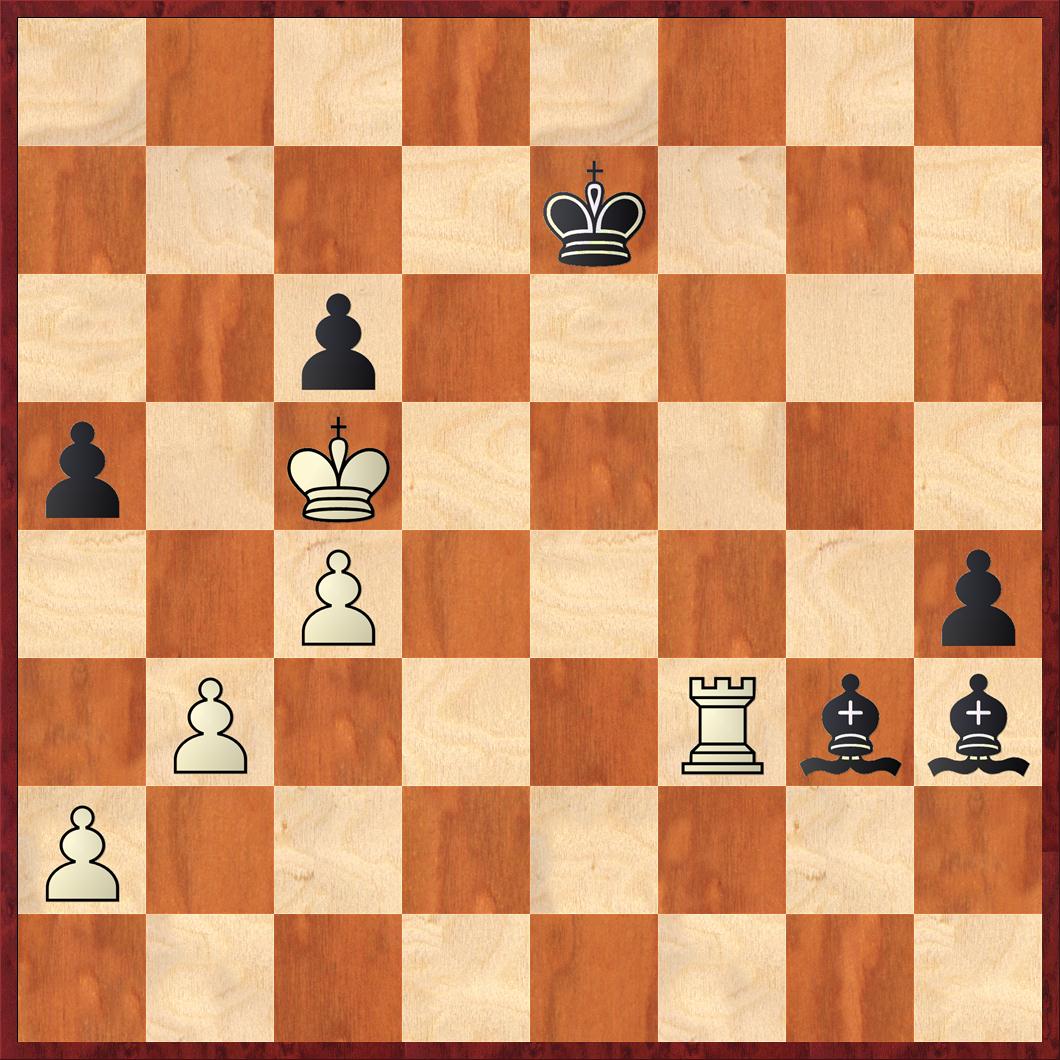
Joe didn't find the winning move over the board. Can you?
You can play through this game here: http://tacticstime.com/?page_id=3284.
Here is a game sent in by Ken Gurge:
[Event
"McMaster Memorial"]
[Site "Fitchburg"]
[Date "2008.07.23"]
[Round "4"]
[White "Ken Gurge"]
[Black "Joe Bennett"]
[Result "1-0"]
[ECO "B86"]
[WhiteElo "1717"]
[BlackElo "1787"]
[Annotator "Gurge,Ken"]
[TimeControl "Game 110 min."]
1. e4 c5 2. Nf3 d6 3. d4 cxd4 4. Nxd4 Nf6 5. Nc3 a6
(all standard [Sicilian Defense, Najdorf Variation -PG])
6. Bc4 (white chooses the Fischer-Sozin Attack over
the main line Bg5 and the Be2 and Be3, which I usually play, lines in order to
avoid the 6...e5 lines)
6... e6 7. Bb3 Be7 (The start of black's troubles. This innocent looking move allows white to play a very aggressive line in the Najdorf- b5 is considered best, but Nbd7 and Nc6, the latter transposing into the Sozin Variation, are also playable)
8. g4 h5 (bad, but not fatal; better is h6 after which 9.Rg1 Nc6 10.Be3 leaves white better)
9. g5 Ng4 10. h4 (an inaccuracy by white which allows black to equalize. Both 10.g6 - due to the threat against e6 - and 10.f4 leave white well ahead and probably winning)
10...Nc6 11. f3 Nge5 (better is 11...Qb6 after which black is better)
12. Be3 b5(?) (likely the losing move, after Na5, black is equal; after the text move, the g7 pawn is lost and black's position starts to crumble)
13.f4 Nxd4 14. Bxd4 Ng4 15. Bxg7 Rg8 16.
Bd4 Bb7 17. Qe2 e5 18. Be3 Qa5 19. O-O-O
Rc8 20. Kb1 Rxc3 21. bxc3 Bxe4 22. Rhe1 Bf5 23. fxe5 Nxe5 24. Qg2 Rg6 25. Qa8+
Bd8 26. Bd4 Re6 27. Bxe5 Rxe5 28. Rxe5+ dxe5 29. Qc6+ 1-0
[Site "Fitchburg, MA"]
[Date "2008.07.09"]
[Round "2"]
[White "Joe Bennett"]
[Black "Dave Couture"]
[Result "1/2-1/2"]
[ECO "A03"]
[WhiteElo "1788"]
[BlackElo "1682"]
[PlyCount "136"]
This was a VERY intense game (my typical self-induced time trouble made it all the more so). Play it over - you won't be disappointed!
I managed to get a pretty big advantage by promoting a
passed pawn. Then Joe threatened with one of his own passed pawns and from
that point on as I looked at variations, I was often changing my evaluation from
win to loss to draw all in the space of 30 seconds or so! We finally end
in a bare-king draw which seemed appropriate.
-Dave Couture
1. f4
I've actually played Bird's myself before, but I still manage to come out of the opening at a disadvantage.
1...d5 2. Nf3 Nf6 3. g3 g6 4. Bg2 Bg7 5. d3 O-O 6. O-O b6 7. c3 Re8
Now we're officially out of book. 7...Bb7 followed by either 8...c5 or 8...Nbd7 is what has previously been played here.
8. Ne5 Ng4 9. Nxg4 Bxg4 10. h3 Bc8 11.
e4 c6 12. e5 d4 13. Na3 Ba6 14. c4 Qc7
15. Nb5 Qd7 16. b3 Bb7 17. Na3 Na6 18. Nc2 Rab8 19. Qe2 c5 20. Ba3 Bxg2 21.
Qxg2 Nc7 22. Rae1 a6 23. b4 Ne6 24. g4 cxb4 25. Bxb4 a5 26. Ba3 b5 27. f5 Nc7
28. c5 b4 29. c6 Qd5 30. Qxd5 Nxd5 31. Bb2 b3 32. Nxd4 bxa2
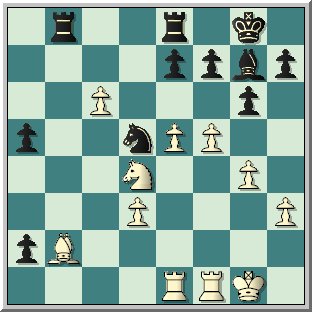
33. Rf2??
33. Ba1 would have worked and kept the position pretty much equal.
33...Nb4?
I played this pretty quickly. I just saw the threat of the knight fork while guarding my advanced a-pawn and went for it. I only saw the Bxe5 tactic a few moves later
34. Rd2
Fritz prefers the counter thrust 34. c7 giving the following line 34. c7 Rbc8 35. Rf3 Rxc7 36. Ba1, but then I could play 36. Rec8 so I'm not sure Fritz is right on this one.
34...Nxd3 35. Rxd3 Rxb2 36. Ra3 Bxe5 37. Rxe5 Rb1+ 38. Kf2 a1=Q 39. Rxa1 Rxa1
40. f6
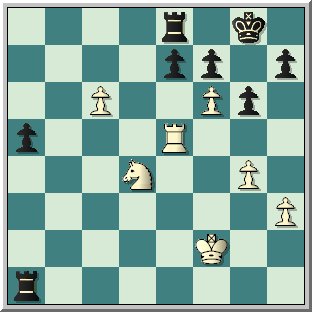
40...e6?
Not good. This pawn became a thorn in my side because of the constant back rank mate threat hanging over my head ("Oh my side! Oh my head!"). I should have played 40...Kf8!
41. Rc5 Rc8 42. Nb5 Rd1 43. Na7 Rc7 44. Rxa5??
He should have played the knight back to b5 for the draw, which is what I was expecting. Instead this gives me what should have been a win, which I will proceed to throw away one inaccuracy at a time.
44...h5 45. gxh5 gxh5 46. Rc5?
Better would have been 46. Rg5+ Kh7 47. Rxh5+ Kg6 48. Ra5
46...Rxa7?
I miss 46...Rd5! which should be winning. For example, 47. Nb5 Rxc5 48. Nxc7 Rxd6 or 47. Rxd5 exd5 48. Nb5 Rxc6 or if white just pulls the rook back 47. Rc4 Ra5!
47. c7 Rxc7 48. Rxc7 Rd2+ 49. Kg3 Rd4 50. Re7 h4+ 51. Kf3 Rd3+ 52. Kg4
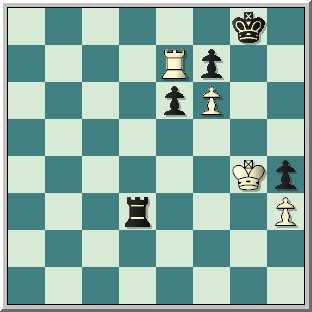
52...Rd4+?!
As soon as I played this, I saw that he could come in with his king and probably eliminate any chance I had to win.
53. Kg5! Kf8 54. Ra7 Rd8 55. Kxh4 Kg8 56. Kg5 e5?
I think 56...Rd3 would have been a draw. Here's a couple of variations: 57. h4 Rf3 58. Ra8+ Kh7 59. Ra5 Rf2 60. h5 Rg2+ 61. Kf4 Rf2+ or 58. Ra5 Kh7 and if he advances the pawn I can just keep checking from behind.
57. Re7 Rd3 58. h4 Rg3+
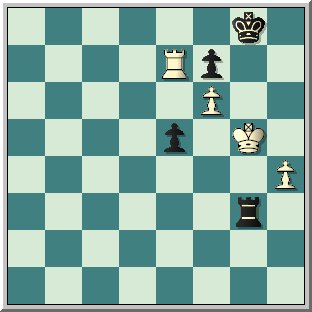
59. Kh5?
Now it's going to be a draw. 59. Kf5 would have kept his chances for a win alive.
59...Rg6 60. Rxe5 Rxf6 61. Rg5+ Kh7 62. Rg3 Rh6+ 63. Kg4 Rg6+ 64. Kh3 Rxg3+
65. Kxg3 Kh6 66. Kg4 f6 67. Kf5 Kh5 68. Kxf6 Kxh4 1/2-1/2
I don't know if I've ever had a game fall apart so quickly and so
completely. The "blunder" I made was not an obvious one, but it WAS huge.
According to Fritz, it was worse than throwing my queen away! After I made the
move and Wayne replied, there were threats everywhere I looked for the remainder
of the game. I could make a contest out of this: See If You Can SPOT THE
BLUNDER :-) Actually, I'll put the answer at the bottom of this page
(*).
-Dave Couture
[Event "2008 WCC Championship Prelims"]
[Site "Fitchburg, MA"]
[Date "2008.04.02"]
[Round "1"]
[White "Wayne Steadman"]
[Black "Dave Couture"]
[Result "1-0"]
[ECO "A46"]
[WhiteElo "1271"]
[BlackElo "1639"]
[PlyCount "45"]
1. Nf3 Nf6 2. d4 c5 3. c3 b6 4. Bf4 d5 5. Qc2 Bg4 6. Nbd2 e6 7. e4 dxe4
8. Nxe4 Bxf3 9. gxf3 cxd4 10. Qa4+ Nbd7 11. Qxd4 Nxe4 12. fxe4 Nf6
13. Bb5+ Nd7 14. O-O-O Be7 15. Qxg7 Bf6 16. Qh6 e5 17. Bxd7+ Qxd7
18. Qxf6 Qxd1+ 19. Rxd1 Rg8 20. Qxe5+ Kf8 21. Bh6+ Rg7 22. Qxg7+ Ke7
23. Qe5# 1-0
This game was a not very welcome "welcome back to the club" game after a little more than 2 months off, but then again Wayne has never been very "welcoming" to me ;-) Despite the difference in ratings, this is the 4th time that he has beaten me! Good game Wayne!
Here is a game that Max Sewell sent in.
Here's the game. The asterisk on move 14 is when I
accidentally
touched my queen with my thumbnail (causing her to spin around and
everything --%$#@!) trying to reach over her for the Knight on d7
(intended Nb6). -Max
Eric Jakobowicz (1824) vs. Max Sewell (1281)
1. f4, d5
2. Nf3, Nf6
3. g3, c5
4. Bg2, Nc6
5. d3, e6
6. 0-0, Be7
7. Nc3, 0-0
8. Bd2, Rb8
9. e4, d4
10. Ne2, b5
11. h3, a5
12. g4, a4
13. g5, Nd7
14. h4, Qe8*
15. Ng3, Nb6
16. h5, c4
17. Qe2, Qd8
18. h6, g6
19. Nh2, Nb4
20. Bxb4, Bxb4
21. Ng4, Nd7
22. dxc4, Qb6
23. c5, Bxc5
24. Kh2, Ba6
25. Qf3, b4
26. Rfe1, Bb7
27. Qe2, Ba6
28. Qf3, Bb7
29. b3, a3?
30. Rad1, f5
31. Nf2, e5
32. fxe5, fxe4
33. Qe2, e3
34. Nd3, Qc7
35. Bxb7, Qxb7
36. Rf1, Qd5
37. Nxc5, Nxc5
38. Rxf8, Rxf8
39. Qxe3, Rd8
40. Qe2, Ne6
41. Rf1, Nxg5
42. Rf6, Nf7?
43. e6, Nxh6
44. e7, Re8
45. Re6, Nf5
46. Nxf5, Qxf5
47. Re5, Qf6?
48. Qc4+, Kg7
49. Qxd4, h5
50. Qe3, Qh4+
51. Kg2, Qg4+
52. Kf2, Qd7?
53. Re6, Qc7
54. Qd4+, Kg8?
55. Rxg6+, Black resigns.
Here is a game that Ken Gurge sent in.
Dave:
It was a pretty interesting game. I played passively in the opening against his Sicilian O'Kelly and decided I needed to sac the exchange for some counterplay. It worked to some degree as I was able to keep the initiative for quite some time. However, he eventually stabilized everything and seemed headed for an endgame win with his extra material. I then sac'ed a knight, which effectively left him up a rook, for connected passed pawns. I pushed them like crazy until one queened and he had to give up his extra rook for it. This still left him up a pawn in a rook and pawn ending. He was able to go up two pawns to zero, but in doing so allowed me to cut his king off from all the action and hang on for the draw. -Ken Gurge
2007 Games
Here is a game that Ken Gurge sent in. It is his first win over former club champion Bruce Felton!
Dave:
Here is my game with Bruce with Fritz evaluations. I
played a speculative 11...Na5 to complicate things rather than the book
11...f6. As I thought at the time he started to go wrong with 14.Bxb6. I think
he expected 14...axb6. I don't care what Fritz says about something better, I
was very proud of 21...Be3 because it kept things complicated and gave him the
opportunity to go wrong by overlooking an x-ray attack on the queen if he
moved to the wrong square, which he did. After move 25, the rest of the game
(38 more moves) was pretty much just grinding out a win with a pawn up.
Although the all seeing Fritz shows where technical improvements could have
been made, I was happy with the way my rook constrained his king and protected
all my pawns until my king could maneuver in for the win. An endgame I didn't
screw up!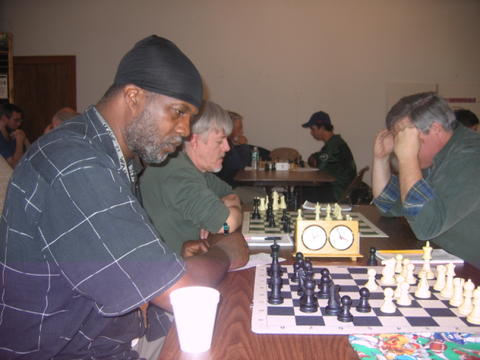
Pictured are Bruce Felton (L.) & Ken Gurge (R.) at next board.
Ken
[Event "John Loyte Memorial"]
[Site "Fitchburg, MA"]
[Date "2007.08.01"]
[Round "4"]
[White "Bruce Felton"]
[Black "Ken Gurge"]
[Result "0-1"]
[ECO "B03"]
[WhiteElo "1838"]
[BlackElo "1712"]
[PlyCount "126"]
1. e4 Nf6 2. e5 Nd5 3. c4 Nb6 4. d4 d6 5.
f4 dxe5 6. fxe5 Nc6 7. Be3 Bf5 8. Nf3 e6 9. a3 Be7 10. Nc3 O-O 11. Be2
S Tidman - S Pertlova 2000 continued 11. Qd2.
11...Na5 ({0.51 Fritz 9:} 11... f6 12. exf6 Bxf6 13. O-O Rf7 14. a4 {[eval -3,13]})
12. b3 Rc8 ({0.84 Fritz 9:} 12... Qd7 13. d5 exd5 14. c5 Nc8 15. b4 Nc4 {[eval 43,14]})
13. d5 ({0.31 Fritz 9:} 13. O-O f6
14. Nh4 fxe5 15. Nxf5 Rxf5
16. Rxf5 {[eval 84,13]})
13... exd5 14. Bxb6 ({-0.65 Fritz
9:} 14. cxd5 Bh4+
15. Nxh4 Qxh4+ 16. Bf2 {[eval 54,13]})
14... cxb6 15. Nxd5 Nc6 ({0.35 Fritz 9:} 15... b5 16. Nxe7+ Qxe7 17. Qd6 Qxd6 18. exd6 bxc4 19. bxc4 Nxc4 20. Bxc4 Rxc4 21. O-O {[eval -65,14]})
16. Qd2 ({-0.26 Fritz 9:} 16. O-O f6 17. exf6 Bxf6 18. Ra2 Kh8 19. Bd3 {[eval 35,13]})
16... Re8 17. Ra2 ({-0.98 Fritz 9:} 17. Qf4 Bg6 18. Rd1 {[eval -25,13]})
17... h6 ({-0.12 Fritz 9:} 17... Be4 18. Nxe7+ Qxe7 19. Qe3 f5 {[eval -98,13]})
18. O-O ({-0.67 Fritz 9:} 18. Qf4 Be6 19. Nxe7+ Qxe7 20. O-O Rcd8 21. Rf2 Bc8 {[eval -12,14]})
18... Bc5+ 19. Kh1 Nxe5 20. Nxe5 ({-1.04 Fritz 9:} 20. Qf4 Nxf3 21. Qxf5 Ne5 22. Bg4 Qh4 23. Bh3 {[eval -34,14]})
20... Rxe5 21. Raa1 Be3 ({-0.46 Fritz 9:} 21... b5 22. Qf4 Bd6 23. Nc3 bxc4 24. Bxc4 b5 {[eval -147,13]})
22. Qc3? ({-2.04 Fritz 9:} 22. Qb2 Qe8 23. Bh5 Rxd5 24. cxd5 Rc2 25. Qb1 {[eval -46,15]})
22... Qxd5 23. Qxe3 Rxe3 24. cxd5 Rxe2 25. Rxf5 Rcc2 26. Rg1 Red2 27. Re5 Kf8 28. Rge1 Rc8?! ({-1.04 Fritz 9:} 28... g6 29. Re7 Rxg2 30. Rxb7 Rxh2+ 31. Kg1 Rcg2+ 32. Kf1 Rd2 {[eval -168,15]})
29. h3 Rd8 30. Re7 R2xd5 31. Rxb7 R5d7
32. Rxd7 Rxd7 33. Re3
f6 34. Kg1 Kf7 35. Kf2 h5 36. h4 Rd5 37. g3 a5 38. a4 g6 39. Kf3 Rf5+ 40. Kg2 b5
41. axb5 Rxb5 42. Kf2 Rf5+ 43. Kg2 Rd5 44. Rc3 Ke6 45. Rf3 g5 46. hxg5 fxg5 47.
Rc3 g4 48. Kf2 Ke5 49. Rc8 Kd4 50. Rc7?? ({-4.01 Fritz 9:} 50. Rb8 Rf5+ 51.
Kg2 Rc5 52. Rd8+ Ke4 53. Re8+ Kd5 54. Rd8+ Kc6 55. Rc8+ Kb6 56. Rb8+ Kc7 57. Re8
Kd7 58. Ra8 Rb5 59. Ra7+ Ke6 60. Kf1 {[eval -124,17]})
50... Kd3?? ({-1.24 Fritz 9:} 50...
Rb5 51. Rc4+ Kd3 52. Kg2
Rxb3 53. Ra4 Rb5 {[eval -401,18]})
51. Rc4?? ({-4.01 Fritz 9:} 51. Rb7 Ke4 52. Re7+ Re5 53. Rb7 Rc5 54. Re7+ {[eval -124,18]})
51... Rb5! 52. Kg2 Rxb3 53. Rc5 a4 54. Rxh5 Rb2+ 55. Kg1 Rb4 56. Rc5 Rc4 57. Rd5+ Kc2 58. Kf2 a3 59. Ra5 Kb3 60. Rb5+ Kc2 61. Ra5 Rc3 62. Ra4 Kb3 63. Ra8 Kb2 0-1
Many adjectives can be applied to this game - interesting, unique, bizarre, and unsatisfying come immediately to mind. All of the adjectives relate to the fact that it was a bishop and knight vs. lone king endgame. This is an endgame I'd never played either side of in spite of 332 previous tournament games and I fully expected that I would NEVER play it in my life! That pretty much explains the 'unique' and 'interesting' aspects. To understand the 'bizarre' and 'unsatisfying' aspects of the game, you'll just have to read (play) on...
[Event "John Loyte Memorial"]
[Site "Fitchburg, MA"]
[Date "2007.08.01"]
[Round "4"]
[White "Ernest Fandreyer"]
[Black "Dave Couture"]
[Result "0-1"]
[ECO "B01"]
[WhiteElo "1299"]
[BlackElo "1562"]
[PlyCount "155"]
1. e4 d5 2. exd5 Nf6 3. c4 e6
Woo-hoo! A chance to play the Icelandic Gambit!
4. Nc3
He doesn't go for it - not fair, not fair! Now what am I supposed to do?! This is the problem with limited experience and even more limited book knowledge.
4...g6?!
Book is 4...exd5.
5. d3?
Fritz gives 5. dxe6 Bxe6 6. d4 Bg7 7. d5 Bf5 +/-
5... Bg7?!
Fritz gives 5... exd5 =
6. Bf4?
Fritz gives 6. dxe6 +/-
6... O-O 7. dxe6 Bxe6 8. h3?!
Regular development with something like 8. Nf3 would be better.
8... Re8 9. Be2 Nc6 10. Nb5 Rc8 11. Qa4?
Fritz gives 11. Nf3 =
11...a6 12. Nc3 Qe7?
Fritz gives 12...b5 13. cxb5 axb5 14. Nxb5 Nd5 15. Bd2 Nb6
13. a3?
Fritz gives 13. a3 =
13... Rcd8 14. Nf3 Nh5 15. Be3 Bxc3+ 16. bxc3 Nf6?
Fritz gives 16. Ng3
17. O-O Bd7 18. Qb3 b6 19. Qb2 Nh5 20. Bg5?? Qxe2 21. Qxe2 Rxe2
22. Bxd8 Nxd8 23. Rfe1 Rxe1+ 24. Rxe1 Nc6 25. d4 Kf8 26. Ng5 h6
27. Ne4 f5 28. d5?
Fritz gives 28. Nd2
28... fxe4 29. dxc6 Bxc6 30. Kh2 Ke7 31. Rd1 Nf4 32. Kg3 Ne2+
33. Kg4 Nxc3 34. Rd2 Bd7+ 35. Kf4 Ke6 36. h4 b5 37. Rc2 Nb1
38. cxb5 Nxa3 39. Rxc7 Nxb5 40. Rc5 Kd6 41. Rc4 Bc6 42. Rc2 Nd4?
Fritz gives 42. Nc7
43. Ra2?
Fritz gives 43. Rd2+
43... Ne6+ 44. Ke3 Nc5 45. Kd4 g5 46. hxg5 hxg5 47. Rc2 Ne6+
48. Ke3 a5 49. Ra2 a4 50. f3 exf3 51. gxf3 Nc7?
Fritz gives 51. Ke5
52. Ra3?
Fritz gives 52. Rg2
52... Ke5 53. Kf2 Nd5 54. Kg3 Bd7 55. Rd3 Bc6 56. Kg4 Kf6
57. Ra3 Bd7+ 58. Kg3 Ke5 59. Rd3 Kd6 60. Ra3 Kc5 61. Kf2 Bb5
62. Ra1 Nc3 63. Kg3 Kb4 64. Kg4 Be2 65. Kxg5 Bxf3 66. Rxa4+??
Kxa4
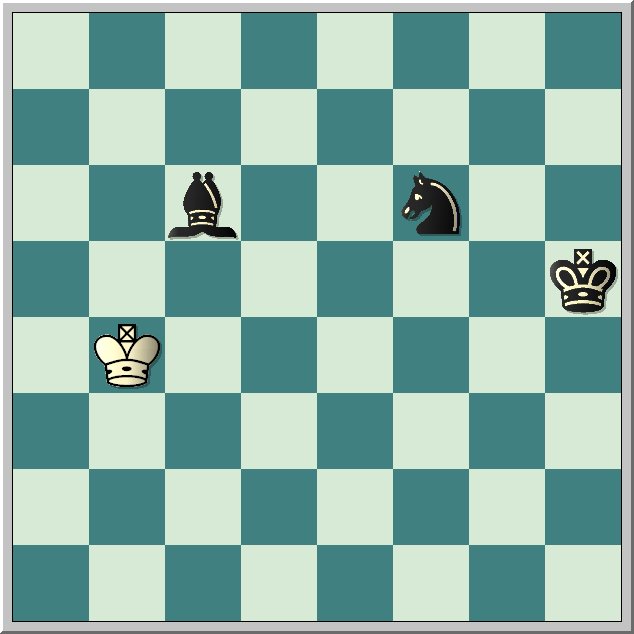
This is the point at which the game became rather bizarre. I chuckled knowing what was ahead of me (especially since I had only 16 minutes left on my clock), but Ernest held his hands up as if this was now a dead draw. I explained that it was a forced mate, but that I was going to have to be very precise to do it within the 50-move rule (i.e. by move 116). He still was convinced that the mate was impossible and seemed to think that I was just messing with him. We played on, but he was so disgusted that he was no longer recording his moves and was rarely even bothering to hit his clock (actually I don't know if he ever hit his clock again from this point on).
Okay, so at this point according to the endgame tablebases, it's mate-in-29 - piece of cake! Plenty of room for error, right?
67. Kf5 Be4+ 68. Ke5 Kb4 69. Kd4 Bc2 70. Ke3?
Ke5 is mate-in-27. This makes it mate-in-23. The main point is that he's moving towards the corner that I want to force him to rather than away from it. I'll take whatever I can get.
70... Kc4 71. Kf4 Kd4 72. Kg5 Nd5?
Now I mess up! Ke5 leads to mate-in-20 whereas my move leads to mate-in-25. I'd say I can't afford too many of these slip-ups, but in this strange situation Ernest's clock is the one that's constantly running regardless of whose move it is...
73. Kg4?
Now it's back to mate-in-20!
73... Ke4 74. Kg3??
Now it's down to mate-in-12. He's heading right towards the corner I want
him to go to all on his own.
74... Bd1 75. Kf2 Ne3 76. Ke1 Kd3 77. Kf2
The game has become distinctly awkward at this point. It's my move and Ernest's time is about to run out, but I haven't been saying anything to him given his mood. I moved quickly to avoid having HIS time run out on MY move.
77... Kd2??
This takes us from mate-in-10 to mate-in-28.
78. Kg3 0-1 (time forfeit)
Well, this was probably my most unsatisfying win ever. I'd really like to know if I could have pulled off the bishop and knight ending under "normal" conditions. The funny thing is that when I first learned chess as a kid I spent a lot of time learning how to do this mate from a library book because it was one of the four basic mates against the lone king and I figured that it occurred just as frequently as a queen vs. lone king or a rook vs. lone king (or 2 bishops vs. lone king for that matter). I knew the configuration that I had to get my 3 pieces in after I drove his king to the "wrong" corner. As it turned out, I never even had to do that since he moved his king to the "right" corner on his own. I guess "a win is a win", but it certainly didn't feel like it tonight.
I would not have wanted to be on the receiving end of this attack! - Dave C
The notes within the game are from Fritz.
Alan Condon's Most Excellent Move!!
-notes by Dave Couture
[Event "David Bronstein Memorial"]
[Site "Fitchburg, MA"]
[Date "2007.02.21"]
[Round "4"]
[White "Alan Condon"]
[Black "Dave Couture"]
[Result "1-0"]
[ECO "D04"]
[WhiteElo "1517"]
[BlackElo "1593"]
[PlyCount "77"]
1. d4 Nf6 2. Nf3 c5 3. e3 d5 4. b3 Nc6 5. Bb2 Bf5 6. Bd3 Bxd3 7. Qxd3 e6 8. O-O cxd4 9. exd4 Bd6 10. a3 O-O 11. Re1 Re8 12. Ne5 h5 13. Nd2 Ng4 14. Qf3 Ncxe5 15. dxe5 Bc5 16. Re2 Qc7 17. Rc1 f5 18. b4 Bb6 19. h3 Bxf2+ 20. Rxf2 Nxf2 21. Qxf2 g5 22. Qe3 Qg7 23. Qd4 g4 24. hxg4 hxg4 25. Qf4 Kf7 26. Nf1 Rh8 27. Ng3 Rac8
Just setting the rook up on the other open file.
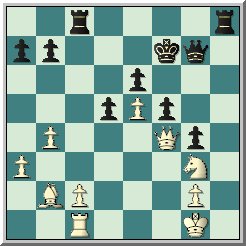
28. Nxf5!!
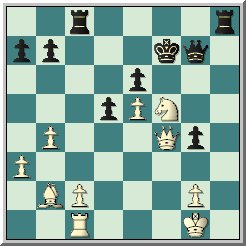
So now the obvious 28...exf5 loses the queen to 29. e6+, but even my best response 29...Qh7 is a loser.
28... Qh7 29. Nd6+ Kg8
29...Ke7 is best, but the prospect of playing on a bishop (and probably a pawn) down wasn't very attractive, so in desperation I figured I'd hope for 30. Nxc8 and whatever I could muster attack-wise down the h-file (which really wasn't anything). In any event, Alan wasn't going for any of it and just punished me for the lousy move.
30. Qxg4+ Kf8 31. Rf1+ Ke7 32. Rf7+ Qxf7 33. Qg5+ Kf8 34. Nxf7 Kxf7 35. Qf6+ Kg8 36. Qxe6+ Kg7 37. Qf6+ Kh7 38. Qf7+ Kh6 39. Bc1# 1-0
Excellent game Alan!
5 Pawns vs. 1 Bishop = Draw?!
[Event "David Bronstein Memorial"]
[Site "Fitchburg, MA"]
[Date "2007.01.24"]
[Round "4"]
[White "Martin Laine"]
[Black "Ken Gurge"]
[Result "1/2-1/2"]
[ECO "A03"]
[WhiteElo "1757"]
[BlackElo "1735"]
[PlyCount "128"]
1. f4 d5 2. b3 Nf6 3. Bb2 {last book move} Bf5 4. Nf3 h6 5. e3 e6 6. Be2 Nbd7 7. O-O Bc5 8. Ne5 Qe7 9. Bf3 Rg8 10. d4 Bd6 11. c4 c6 12. Nc3 Ba3?!
Fritz gives (12... g5 13. c5 Bc7 14. b4 gxf4 15. exf4 Ne4 16. Qe2)
13. Qc1 Bxb2 14. Qxb2 a6 15. Rac1 Nxe5?
Fritz gives (15... g5 16. Qd2 g4 17. Be2 g3 18. h3 Nb6)
16. fxe5 Ne4 17. cxd5 exd5 18. Nxe4 dxe4 19. Bd1 Be6 20. Bc2 Qg5 21. Rf4 f5 22. exf6 gxf6 23. Bxe4 O-O-O 24. Bxc6?
Fritz gives (24. Rc5 Bd5 25. Qf2 Kb8 26. Rxf6 Rgf8 27. Rf4 Ka8 28. Bf5 Bxf5)
24... bxc6 25. Rxc6+ Kd7 26. Rxa6 Bh3?
Fritz gives (26... Bd5 27. g3 f5 28. Qc2 Rc8 29. Qxf5+ Qxf5 30. Rxf5 Rc1+)
27. g3?
Fritz gives (27. Ra7+ Ke6 28. d5+ Rxd5 29. Rxf6+ Qxf6 30. Ra6+ Kd7 31. Rxf6 Rxg2+ 32. Qxg2)
27... Qb5??
Fritz gives (27... Rc8! 28. Qd2 Rge8 29. Raxf6 Qd5)
28. Raxf6??
Fritz gives (28.Ra7+! Kd6 29. Rxf6+ Be6 30. Qa3+ Kd5 31. Ra5 Rb8 32. Qb4 Ke4)
28... Rde8??
Fritz gives (28... Qd3 29. Qc1 Rc8 30. Qe1 Qc2 31. Rf2 Qc1 32.Re2 Qa3 33. Qd2)
29. Qc3??
Fritz gives (29. Rxh6 Rxe3 30. Rxh7+ Re7 31. Rxe7+ Kxe7 32. Qa3+ Kd8 33. Qd6+ Bd7 34. Rf8+ Rxf8 Qxf8+ +-)
29...Qb7??
Fritz gives (29... Rc8 30. Qd2 Rc6 31. e4 Rxf6 32. Rxf6 rg6 33. Rf7+ Ke8 34. Rf2 Qb6 +-)
30. Rf7+??
Fritz gives (30. d5 Re7 31. Rxh6 Rc8 32. Qd2 Qa7 33. Rxh3 Rxe3)
30... Re7 31. Rxe7+ Kxe7 32. Qc5+ Kd8 33. Rf8+ Rxf8 34. Qxf8+
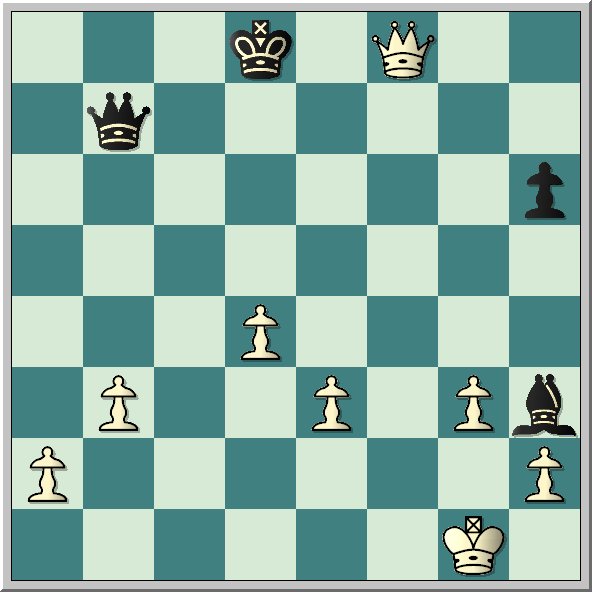
34...Kc7 35. Qe7+ Bd7 36. Qc5+ Kd8??
Fritz gives (36... Qc6 37. Qxc6+ Bxc6 38. g4 Bf3 39. h3 Kd6 40. Kf2 Be4 41.h4)
37. d5??
Fritz gives (37. Qf8+ Be8 38. Qxh6 Qe4 39. Qf6+Kd7 40. Qf4 Qb1+ 41. Qf1 Bg6)
37... Qa6 38. a3?
Fritz gives (38. Qf8+ Kc7 39. Qf4+ Kb7 40. Qf7 Kc7 41. h3 Qe2 42. Qf4+ Kb7)
38... Qe2 39. Qf8+ Kc7 40. Qf2 Qd1+ 41. Kg2 Qxd5+ 42. Qf3 Qxb3?
Fritz gives (42... Qd2+ 43. Qf2 Bc6+ 44. e4 Bxe4+ 45. Kg1 Qd1+ 46. Qf1 Qxf1+ 47. Kxf1 Kc6 48. g4 Bf3 49. h3 Kb5)
43. Qf4+ Kc8 44. Qf8+ Kc7 45. Qxh6 Qxa3?!
Fritz gives (45... Qa2+ 46. Kf3 Qd5+ 47. Ke2 Qa2+ 48. Ke1 Qa1+ 49. Kf2 Qa2+ 50. Kg1 Qb1+)
46. Qf4+ Kd8 47. h4?
Fritz gives (47. Qg5+ Ke8 48. Qh5+ Ke7 49. Qh4+ Kf7 50. Qh7+)
47... Qa2+ 48. Kf3 Qa8+ 49. e4 Qa3+ 50. Qe3 Qf8+ 51. Kg2 Qb4 52. Qg5+ Kc7 53. Kf3 Qc3+ 54. Qe3 Qg7 55. Qc5+ Bc6 56. g4 Qf6+ 57. Kg3 Qe6 58. Qc2 Qd6+ 59. Kh3 Qa3+ 60. Kg2 Qe3 61. g5 Kd7 62. Qf2 Bxe4+ 63. Kg1 Qc1+ 64. Qf1 Qxf1+ 1/2-1/2
[Event "David Bronstein Memorial"]
[Date "2007.01.17"]
[Round "3"]
[White "Ken Gurge"]
[Black "George O'Rourke"]
[Result "1-0"]
[ECO "B75"]
[WhiteElo "1735"]
[BlackElo "1819"]
[PlyCount "65"]
1. e4 c5 2. Nf3 d6 3. d4 cxd4 4. Nxd4 Nf6 5. Nc3 g6 6. Be3 Bg7 7. f3 O-O 8. Qd2 Nc6 9. O-O-O
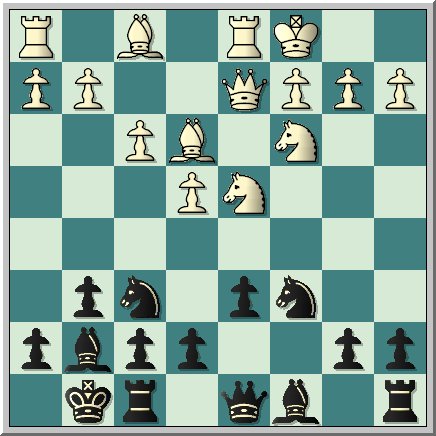
George Mirijanian sent the following email to Ken G. and George O.:
Ken/George -
I was checking out the variation you guys played Wednesday and found that 9. 0-0-0 (which Ken played) was the natural continuation for many years until it was replaced by 9. Bc4, which became very popular in the 1960s.
After 9. 0-0-0, Black has basically three major continuations:
9...Nxd4
9...Be6
9...d5
After 9...Nxd4 10. Bxd4 could follow 10...Be6 and now White may have nothing better than 11. Kb1 (which prevents 11...Qa5 because of 12. Nd5!), but not 11. g4 because of 11...Qa5 . After 11. Kb1 Black plays 11...Qc7 and follows it up with ...Rfc8 and seeks counterplay on the queen flank.
After 9...Be6, White should not play 10. Nxe6, since Black now controls the d5 square and should get good piece play.
The gambit continuation 9...d5 is the most critical of all the variations. After 10. exd5 Nxd5 11. Nxc6 bxc6 12. Nxd5 cxd5 13. Qxd5, Black's bet is 13...Qc7, for after 14. Qxa8? Bf5 15. Qxf8+ Kxf8 16. Rd2 Black can minimize his problems by playing 16...h5!
The line that is most interesting after 13. Qxd5 Qc7 is 14. Qc5 Qb7, for now following 15. Qa3 Bf5 what is White to do? After 16. Ba6 Qc7 17. Qc5, Black may have nothing better than 17...Qb6 and White now has nothing better than 18. Qxb6, since 18. Qa3? allows 18...Bxb2+ 19. Qxb2 Qxe3+!
The 9...d5 continuation is the most complicated of all the variations and the most interesting one.
George M
Ken sent the following reply:
9.Bc4 and 9.0-0-0 seem to be played about equally these days.
After 9.0-0-0, ...Bd7 is also a viable option for black as George played and after 10.g4, black can vary with Qa5 or play Rc8 as George did, but then after 11.h4 Ne5 12.h5, Qa5 is probably better than Nxg4.
In your 9...Nxd4 line, white plays either 12.g4 or h4 and after black's 12...Rfc8, the race to see who gets to the king first is on.
After 9...Be6, 10. Nxe6 is fine according to my database. White wins 100% of reported games after 10...fxe6 and any of 11.Kb1, g3, or Bc4.
9...d5 is certainly the most often played move and as you note by far the most complicated. Nonetheless, I still prefer white in the Dragon variations.
Ken G.
9... Bd7 10. g4 Rc8 11. h4 Ne5 12. h5 {last book move}
12... Nexg4 13. fxg4 Bxg4 14. hxg6 fxg6 15. Be2 Rxc3 ({4.79 Fritz 9:} 15... Rf7 {[eval 290,13]})
16. Qxc3 Bxe2 17. Nxe2 Kh8 18. Qc4 Nh5 19. Rhf1 Bf6 20. Nf4 Nxf4 21. Rxf4 Qe8 22. Rdf1 Qd8 23. R4f3 Kg7 24. Qd5 h6 ({8.91 Fritz 9:} 24... Qe8 {[eval 605,13]})
25. Kb1 Qc8 26. Bd4 Qg4 ({12.04 Fritz 9:} 26... g5 27. Bxf6+ Rxf6 28. Rxf6 exf6 29. Qxd6 Qf8 30. Qxf8+ Kxf8 31. Rxf6+ Kg7 32. Rd6 h5 33. Rd7+ {[eval 657,13]})
27. Bxf6+ Rxf6 ({15.96 Fritz 9:} 27... exf6 28. Qxd6 Qg5 29. Rc3 Qe5 30. Rc7+ Kg8 31. Qd7 Qxc7 32. Qxc7 a5 33. Qxa5 {[eval 1204,15]})
28. Rxf6 exf6 29. Qxb7+ Kh8 30. Qb8+ Kg7 31. Qc7+ Kg8 32. Qd8+ Kh7 33. Qxf6 1-0
2006 Games
A Very Instructive Endgame
Watch (and hopefully learn) as two 1500+ players miss forced-win after forced-draw after forced-win after forced-draw...
-Dave Couture
[Event "2006 George Sturgis Memorial"]
[Site "Fitchburg, MA"]
[Date "2006.12.13"]
[Round "3"]
[White "Tom Fratturelli"]
[Black "Dave Couture"]
[Result "1/2-1/2"]
[ECO "B01"]
[WhiteElo "1547"]
[BlackElo "1584"]
[PlyCount "131"]
1. e4 d5 2. exd5 Nf6 3. Nf3 Nxd5 4. d4 Nc6?!
4...g6 is most common here.
5. Be2 Bf5 6. a3 e6 7. O-O Be7 8. c4 Nf6 9. Nc3 Qd7?
This just gets me into trouble later as Tom slowly strangles me.
10. Be3 O-O 11. b4 h6 12. b5 Nd8 13. Ne5! Qc8 14. Qd2 c6 15. a4 cxb5 16. axb5 b6 17. Bf3 Nb7 18. Nc6 Qc7 19. Ra4 Ng4 20. Bf4 Bd6 21. Bxd6 Qxd6 22. Bxg4 Bxg4 23. Rfa1 a5 24. bxa6 Qxc6 25. axb7 Qxb7 26. Nb5 Rxa4 27. Rxa4 Qe4
Not fearing the 28. f3 fork because of 28...Qb1+.
28. Ra1
NOW I need to worry about the f3 fork, but forget to.
28... Rd8
Of course as soon as I moved the rook, I remembered the fork! Hmmm... I think this sort of thing explains my rating.
29. f3
My first instinct as soon as I had realized my blunder was that I was going to take with my bishop, but I prefer my next move. Also, Tom was down to about a minute per move and I liked the complications that 29... Qc6 caused.
29... Qc6 30. fxg4 Qxc4 31. Rb1 e5 32. Rb4 Qe6 33. Qe2 Qe7 34. Rb1 e4 35. Re1 Qb4 36. h3 Rd5 37. Nc7 Rxd4 38. Rf1 Rd2 39. Qe3 Rd7 40. Qf4??
My clock has a feature whereby it beeps when a player has 10 seconds left. Before Tom made his 40th move, it beeped! I think he made this move with 8 seconds left!
40... Qc5+ 41. Kh1 Qxc7 42. Qxe4 Qd6?!
I completely overlooked Tom's reply. Perhaps I should have played 42...Rd8.
43. Qe8+ Kh7 44. Rxf7 Rxf7 45. Qxf7
In "Basic Chess Endings" Reuben Fine writes, "Endings where both sides have queens and pawns are notoriously difficult. One pawn ahead wins even less frequently than in rook endings, and with two pawns up the win is still not smooth sailing."
The more I looked at this position, the more complex it looked. It certainly looked like it was going to be tough to advance the pawn and protect myself from a perpetual check at the same time.
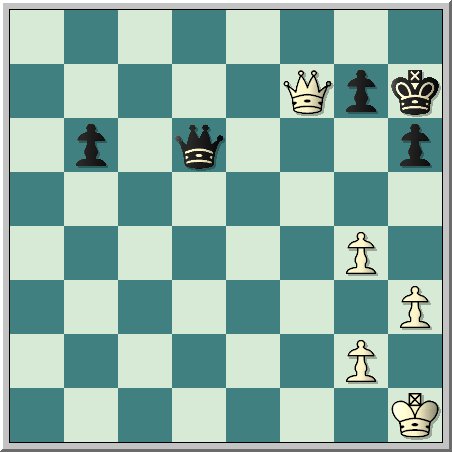
45... Qe5 46. Qb3 b5 47. Qd3+ Kg8 48. Qb3+ Kf8 49. Qb4+ Ke8 50. Kg1 Qd5 51. Kf2 Qc4?
Check this out: Fritz gives this as a mistake, giving the line 51... Qf7+ 52. Kg3 and only THEN 52...Qc4. You may ask, "What if white plays 52. Ke3?" Then Fritz gives 52...Qe7+! 53. Qxe7+ Kxe7 with the distant opposition and a winning advantage! Okay back to the game...
52. Qxc4 bxc4 53. Ke2??
This loses, but only if I play Kd7. Tom should have played 53. Ke3 taking one less move to get to the pawn (pointed out by Parker Montgomery).
53... Ke7??
Here's the winning line given by Fritz: 53...Kd7 54. Ke3 Kc6 55. Kd4 Kb5 56. Kc3 g5! and black wins.
54. Kd2??
Once again giving me a chance to win. We were both very generous to each other without realizing it at the time. I thought I had it won from the time we had exchanged queens, by virtue of having the outside passed pawn. My best calculations, which turned out to be VERY incomplete, showed me winning.
54... Ke6 55. Kc3
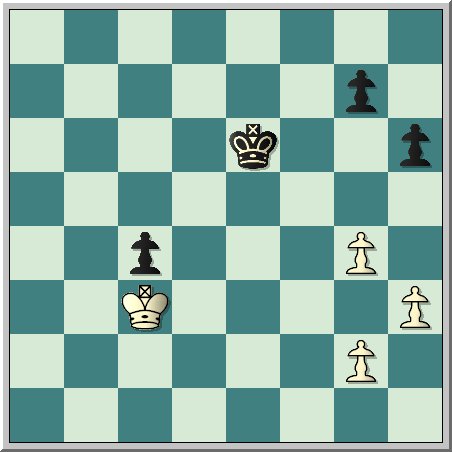
55... Ke5??
Giving the draw back to Tom! As I said previously, my calculations were woefully incomplete. I still thought I had a forced win here. I now realize, as Parker pointed out, that 55...Kd5 wins.
56. Kxc4 Kf4 57. Kd5??
The drawing move is 57. g5. Then if 57...h5, white plays 58. Kd5. If instead black plays 57...Kxg5, then white plays 58. g3!
57... Kg3??
And the winning move would have been none other than 57...g5! So then 58. Ke6 Kg3 59. Kf5 Kxg2 and wins.
58. Ke5??
g5 still draws...
58... Kxg2??
...and yes g5 still wins...
59. Kf5??
...and (yawn) g5 still draws.
59... Kxh3 60. g5 h5 61. Kg6 h4??
At this point I was only playing on in the slim hope that Tom would move his king onto the h-file after capturing my pawn. I was just playing mechanically. This is one of those points where it would be nice if someone would tap me on the shoulder, clear their throat and say, "Take a REALLY good look at the position." Hopefully everyone reading this is taking notes ;-)
As Parker pointed out AFTER the game (please read the previous sentences Parker - yuk, yuk), even at this late stage I STILL had a win - 61...Kg4 and it's all over - a full point for a hard night's work, but as I said I didn't even pause for a second to look at it.
62. Kxg7 Kg2 63. g6 h3 64. Kf8
Ah well...
64... h2 65. g7 h1=Q 66. g8=Q+ 1/2-1/2
[Event "LeBlanc Memorial"]
[Date "2006.11.15"]
[Round "5"]
[White "Ken Gurge"]
[Black "Parker Montgomery"]
[Result "0-1"]
[ECO "C96"]
[WhiteElo "1668"]
[BlackElo "1970"]
[PlyCount "116"]
1. e4 e5 2. Nf3 Nc6 3. Bb5 a6 4. Ba4 Nf6 5. O-O Be7 6. Re1 b5 7. Bb3 O-O 8. c3 d6 9. h3 Na5 10. Bc2 c5 11. d3 Qc7 12.
Nbd2 Re8 13. Nf1 h6 {last book move} 14. Ne3 Bb7 15. Nf5 Bf8 16. Nh2 Kh7 ({0.76 Fritz 9:} 16...d5 17. Ng4 Nxg4 18. Qxg4 Kh8 19. Ne3 d4 {[eval 42,13]})
17. Ng4 Ng8 18. Qf3 ({0.20 Fritz 9:} 18. Nfe3 g6 19. b4 cxb4 20. cxb4 Nc6 21. Nd5 {[eval 86,14]})
18... g6 19. Nfxh6 ({-0.69 Fritz 9:} 19. Nh4 f5 20. Ne3 Qg7 21. Qe2 Qf6 {[eval 21,14]})
19... Bxh6 20. Bxh6 Nxh6 21. Nf6+ Kg7 22. Nxe8+ Rxe8 23. Qg3
Qe7 24. h4 ({-0.95 Fritz 9:} 24. a3 Nc6 25. b4 Qc7 26. bxc5 dxc5 27. Qe3 {[eval -40,14]})
24... Qf6 25. Re3 Bc8 26. Rf3 Qe6 27. h5 Qg4 28. hxg6 fxg6 29. Bb3 ({-1.59 Fritz 9:} 29. Qxg4 {[eval -89,14]})
29... Qxg3 30. Rxg3 Rf8 ({-0.60 Fritz 9:} 30... Nxb3 31. axb3 Nf7 32. Rc1 Nd8 33. d4 exd4 34. cxd4 Ne6 35. d5 {[eval -130,15]})
31. Bd5 Ng4 ({1.25 Fritz 9:} 31... Bb7 32. Bxb7 Nxb7 33. Rd1 Ng8 34. d4 Nf6 {[eval -52,14]})
32. Rf1 ({-1.04 Fritz 9:} 32. b4 cxb4 33. cxb4 Nf6 34. bxa5 Nxd5 35. exd5 Bb7 36. Rg4 Bxd5 {[eval 125,15]})
32...Nf6 33. Bb3 ({-1.54 Fritz 9:} 33. b4 Nb7 34. Re3 g5 35. Rfe1 Kg6 {[eval -108,14]})
33... Nh5 34. Re3 Nf4 35. Bc2 Nc6 36. f3 g5 ({-1.12 Fritz 9:
} 36... d5 37. exd5 Nxd5 38. Ree1 Bf5 39. g3 b4 40. Ba4 Nde7 {[eval -164,15]})
37. g4 ({-2.69 Fritz 9:} 37. g3 Nh5 38. Kf2 Be6 39. a3 Nf6 40. Ree1 {[eval -112,15]})
37... Rh8 38. a4 b4 39. Bb3 Nh3+ 40. Kg2 Nf4+ ({0.00 Fritz 9:} 40... Na5 {[eval -269,14]})
41. Kg1 Kf6 42. Bd5 Ne7 43. Bc4 Nc6 ({0.00 Fritz 9:} 43... Rh3 {[eval -300,14]})
44. Bd5 Nxd5 45. exd5 Ne7 46. c4 Ng6 47. Rf2 ({-3.58 Fritz 9:} 47. Re2 Bd7 48. b3 {[eval -223,18]})
47... Bd7 48. b3 Nf4 49. Rh2 Rxh2 50. Kxh2 Be8 51. Re1 Bg6 52. Rd1 ({-6.96 Fritz 9:} 52. Kg1 Bxd3 53. Re3 Bc2 54. Kf1 Nd3 55. Ke2 Nc1+ 56. Kd2 Bxb3 57. Kxc1 Bxc4 58. a5 Bxd5 {[eval -455,20]})
52... Bxd3 53. Rd2 e4 54. fxe4 Ke5 55. Kg3 Ne2+ 56. Kf2
({-8.16 Fritz 9:} 56. Kf3 Nd4+ 57. Ke3 Bc2 58. Rf2 Bxb3 59. Rf7 Bxa4 60. Re7+ Kf6 61. Ra7 a5 62. Ra8 b3 63. Rb8 Bd7 64. Kd3 {[eval -546,20]})
56... Kxe4 57. a5 ({-12.57 Fritz 9:} 57. Rd1 Kd4 58. Rh1 {[eval -760,20]})
57... Nd4 58. Rb2 Bc2 0-1
Before this game I told Ernest that I needed to be careful against him because he had beaten me once before. Obviously I wasn't careful enough! I'm now 1-2 against Ernest in spite of the rating difference.
-Dave Couture
[Event "J. Camille LeBlanc Memorial"]
[Site "Fitchburg, MA"]
[Date "2006.11.08"]
[Round "4"]
[White "Ernest Fandreyer"]
[Black "Dave Couture"]
[Result "1-0"]
[ECO "B01"]
[WhiteElo "1170"]
[BlackElo "1654"]
[PlyCount "137"]
1. e4 d5 2. c3?!
I've never seen this before and in an effort to keep the game from getting too interesting tactically I play the conservative Caro-Kann-like...
2... c6?!
Fritz has no qualms with capturing the pawn, giving the following line: 2...dxe4 3. Qa4+ Nc6 4. Qxe4 Nf6 5. Qe3 Nd5 =/+.
3. exd5 cxd5 4. d4 Nf6 5. Na3 a6 6. Nf3 Bg4 7. h3 Bh5 8. g4 Bg6 9. Ne5 e6 10. Nxg6 hxg6 11. f3?!
Unnecessarily weakens the kingside.
11... Qc7 12. Be3 Bxa3 13. bxa3?!
Qa4+ is a better way to recapture the bishop.
13... Qxc3+ 14. Bd2?!
It would have been better to play Kf2 and drop the a-pawn instead of the d-pawn.
14... Qxd4 15. Rb1 Qe5+ 16. Qe2 Qxe2+?!
For some reason, Fritz thinks Qc7 is significantly better. Who am I to question Fritz (especially after THIS game)?
17. Bxe2 b5 18. O-O?!
Drops another pawn. Gee, I'm up 3 pawns and about 500 rating points. I guess I can sit back and relax - famous last words!
18... Rxh3 19. Kg2 Rh8 20. Rh1 Rxh1 21. Rxh1 Nbd7 22. Rh8+ Nf8 23. Bb4 N6d7 24. Rg8 a5?
Here I miss a tactic. My intent was to drive the bishop off the diagonal where it was guarding the knight. First I'd force it to d6, then I'd play Ra6 to get it off the diagonal.
25. Bd6
Now that he actually PLAYED Bd6 I saw that 25...Ra6 would lose to 26. Bxf8 Nxf8 27. Bxb5+! I think it was right about here where Angel Soto came by and said "You're in trouble man!"
25... Rc8?!
Now in my "flustration" (if I may coin a word) I follow a weak move with yet another weak move. 25... f5 would have been better first or I could even have CASTLED which I had completely forgotten about!
26. Bxb5
Once I realized that both knights were pinned, I had about 10 seconds where my stomach dropped out thinking that it was going to be a forced mate-in-1 with Rxf8#!
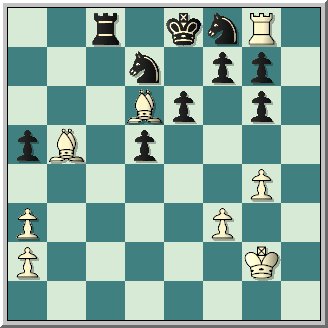
26... Rc2+ 27. Kg3 Kd8 28. Bxf8 Nxf8 29. Rxf8+ Ke7 30. Ra8 Rc5 31. Rxa5 Kf6 32. a4 d4 33. Kf4 Rd5?
Fritz gives the much more aggressive 33...e5+ 34. Ke4 Kg5, but George Mirijanian pointed out that I probably needed to play g5+ here before Ernest did so that I could keep my king safe from checks that could allow him to queen his a-pawn.
34. Ra6?
After I moved I was worried that he was going to play Ra7 which Fritz actually likes. Fritz gives the following line: 34. Ra7 e5+ 35. Ke4 Rc5 36. f4 exf4 37. Kxd4.
34... d3 35. Bc4?
Ernest misses the chance to push my king back with 35. g5+ Ke7 36. Ra7+ Kd8 37. Ke4 d2 38. Be2 d1Q 39. Bxd1 Rxd1 40. Rxf7 and white is in good shape.
35... d2 36. Bb3 d1=Q 37. Bxd1 Rxd1 38. g5+ Ke7 39. Ra7+ Ke8 40. a5 Ra1
I've been aware for some time that all I should have to do is keep my rook behind his a-pawn and he won't be able to queen it. Watch how quickly I forget!
41. a6 Rxa2 42. Ke5 Rd2??
I'm amazed at the number of mental lapses I made tonight. I was thinking that I wanted to keep his king from coming over to assist the a-pawn and completely forgot about keeping my rook behind the a-pawn. Ernest didn't forget!
43. Rb7! Rd5+ 44. Ke4 f5+ 45. gxf6 gxf6 46. a7 f5+ 47. Kf4 Ra5 48. Rb8+ Kf7 49. a8=Q Rxa8 50. Rxa8 Kf6 51. Ra6 g5+ 52. Ke3 Ke5 53. Ra5+ Kf6 54. Kd4 g4 55. fxg4 fxg4 56. Ke4 g3 57. Kf3 g2 58. Kxg2 e5 59. Kf3 Kf5 60. Ke3 Ke6 61. Ke4 Kd6 62. Rxe5 Kc6 63. Kd4 Kd6 64. Rd5+ Ke6 65. Kc5 Kf6 66. Kd6 Kf7 67. Rf5+ Ke8 68. Rf6 Kd8 69. Rf8# 1-0
Congratulations Ernest!
[Event "LeBlanc Memorial"]
[Site "Leominster"]
[Date "2006.11.08"]
[Round "4"]
[White "Larry Gladding"]
[Black "Ken Gurge"]
[Result "0-1"]
[ECO "B02"]
[WhiteElo "1865"]
[BlackElo "1668"]
[PlyCount "126"]
1. e4 Nf6 2. e5 Nd5 3. g3 d6 4. exd6 exd6 5. Bg2 {last book move} c6 6. d4 Nb6 7. Ne2 Bf5 ({0.09 Fritz 9:} 7... d5 8. a4 Be7 9. Nd2 Bf5 10. Nf1 O-O 11. Ne3 {[eval -28,15]})
8. O-O Be7 9. Nd2 d5 10. Nf3 N8d7 11. Re1 O-O 12. Nf4 Re8 13. Nd3 Bf6 14. Nde5 Be4 15. Nxd7 ({-0.95 Fritz 9:} 15. Bf4 Nf8 16. Bh3 Ne6 17. Nd2 Bxe5 {[eval -32,13]})
15... Nxd7 ({-0.49 Fritz 9:} 15... Qxd7 16. c3 Qf5 17. b3 a5 18. Bf4 Nd7 19. h3 {[eval -95,15]})
16. Bf4({-1.11 Fritz 9:} 16. c3 Qb6 17. Re2 Nf8 18. Be3 {[eval -49,13]})
16... Qb6 17. Ne5 ({-1.73 Fritz 9:} 17. c3 Qxb2 18. Qb3 Qxb3 19. axb3 h6 20. Bd6 {[eval -107,13]})
17... Bxe5 ({-0.91 Fritz 9:} 17... Nxe5 18. dxe5 Bxe5 19. Bxe4 Bxf4 20. Bxh7+ Kxh7 21. gxf4 Rxe1+ {[eval -173,14]})
18. dxe5 Bxg2 19. Kxg2 Re6 20. c4 Rd8 ({-0.11 Fritz 9:} 20... dxc4 21. Qxd7 Rd8 22. Be3 Rxd7 23. Bxb6 {[eval -76,14]})
21. cxd5 cxd5 22. Bg5 Rde8 23. Qxd5 Nxe5 24. Rad1 Qc6 ({0.30 Fritz 9:} 24...Qxb2 25. Rb1 Qc3 26. Rec1 Qa3 27. Rxb7 {[eval -29,14]})
25. b4 ({-1.65 Fritz 9:} 25. Qxc6 Nxc6 26. Rxe6 Rxe6 27. Be3 a5 28. h4 b5 29. g4 a4 30. h5 {[eval 30,15]})
25... Qxd5+ ({0.06 Fritz 9:} 25... Nd3 26. Rxd3 Qxd5+ 27. Rxd5 Rxe1 28. Rd7 a6 29. Rxb7 h6 30. Be3 {[eval -165,16]})
26. Rxd5 f6 27. Be3 Ng4 28. Rd7 Nxe3+ 29. Rxe3 Rxe3 30. fxe3 Rxe3 31. Kf2 ({-0.79 Fritz 9:} 31. a4 Re2+ 32. Kg1 Ra2 33. a5 b6 34. Rxa7 bxa5 35. Rxa5 Rb2 {[eval -11,15]})
31... Ra3 32. Rd2 ({-1.43 Fritz 9:} 32. Rxb7 Rxa2+ 33. Kg1 a6 34. h3 Rb2 35. Ra7 Rxb4 36. Rxa6 Kf7 37. Kf2 {[eval -79,16]})
32... b5 33. Ke2 Rc3 ({-0.46 Fritz 9:} 33... Kf7 34. Rb2 f5 35. Kf2 g6 36. h3 g5 37. Rc2 {[eval -148,14]})
34. Rd8+ Kf7 35. Rd7+ Kg6 36. Rxa7 Rc2+ 37. Kf3 ({-0.81 Fritz 9:} 37. Kd3 [eval -27,18]})
37... Rxh2 38. Ra5 h5 39. a3 Ra2 40. Ke3 f5 ({-0.16 Fritz 9:} 40... Kh6 {[eval -118,16]})
41. Kf4 Rf2+ 42. Ke3 Ra2 43. Kf4 Rf2+ 44. Ke3 Ra2 45. Ra6+ ({-1.64 Fritz 9:} 45. Kf4 {[eval 0,20]})
45... Kg5 46. Kf3 h4 ({-0.11 Fritz 9:} 46... Rb2 47. Ra7 g6 48. Ra6 Rb1 49. Kg2 Rd1 50. Kf3 Rd3+ 51. Kf2 {[eval -152,18]})
47. gxh4+ Kxh4 48. Kf4 ({-1.15 Fritz 9:} 48. Rg6 Rxa3+ 49. Kf4 Ra7 50. Kxf5 Rf7+ 51. Ke6 Rb7 52. Kf5 Rd7 53. Ke6 {[eval -11,19]})
48... Rf2+ 49. Ke3 Ra2 ({0.00 Fritz 9:} 49... Rg2 50. Kf4 g5+ 51. Kxf5 Rf2+ 52. Ke4 g4 53. Rh6+ Kg5 54. Rh7 g3 55. Rg7+ Kh4 56. Rh7+ Kg4 {[eval -82,18]})
50. Kf3 ({-1.84 Fritz 9:} 50. Kf4 {[eval 0,21]})
50...Kg5 51. Ra5 g6 52. Kg3 Kh5 ({-0.79 Fritz 9:} 52... Kf6 {[eval -203,19]})
53. Ra8 ({-2.20 Fritz 9:} 53. Kf4 Kh6 54. Rxb5 Rxa3 55. Rc5 Rh3 56. b5 Rb3 57. Ke5 Kg5 58. Kd6 Kg4 {[eval -79,18]})
53... Kg5 ({0.00 Fritz 9:} 53... g5 54. Rh8+ Kg6 55. Rg8+ Kf6 56. Ra8 Ke5 57. Re8+ {[eval -220,18]})
54. Ra5 Ra1 ({-1.17 Fritz 9:} 54... Kf6 {[eval -175,18]})
55. Ra6 ({-3.99 Fritz 9:} 55. Kf3 Rb1 56. Rxb5 Rb3+ 57. Ke2 Rxa3 58. Kd2 Kg4 59. Ra5 Rh3 60. b5 f4 61. Ra6 g5 {[eval -117,18]})
55... f4+ 56. Kf2 ({-5.38 Fritz 9:} 56. Kf3 Re1 57. Kf2 Re3 58. a4 bxa4 59. Rxa4 {[eval -399,19]})
56... Kh5 57. Ra5 ({-5.38 Fritz 9:} 57. Kf3 g5 58. Ra8 Rf1+ 59. Ke2 Rb1 60. Kf3 Rb3+ 61. Ke4 Kg4 62. Kd5 f3 63. Rf8 Rc3 64. a4 {[eval -386,18]})
57... Kg4 58. Rxb5 Rxa3 59. Rc5 Ra2+ 60. Kf1 Rb2 61. b5 g5 62. Rd5 f3 63. Rd4+ ({-#49 Fritz 9:} 63. Ke1 Kf4 64. Rd8 Rxb5 65. Rf8+ Rf5 66. Rd8 g4 67. Rh8 Re5+ 68. Kf1 Kg3 {[eval -746,17]})
63... Kg3 0-1
Notes by Larry Gladding.
J. Camille LeBlanc Memorial
Round 2
Sicilian Defense
Najdorf Variation
White: Mirijanian (1935) O
Black: Gladding (1865) 1
1. e4 c5 2. Nf3 d6 3. d4 cxd4 4. Nxd4 Nf6 5. Nc3 a6 6. Bg5 e6 7. f4 Qc7 (In past games with George I always played 7.....Be7. However, after 8. Qf3 Qc7 9. O-O-O Nbd7 10. g4 , no matter how much theory I studied from this point on George always managed to get a decisive advantage)
8. Bxf6 gxf6 9. Qh5 (Now I'm out of book. I saw this move as a side note but couldn't remember the continuation. Two references give 9...Qc5 is safe for Black and 9...Qc5 10. Qxc5 dxc5 and Black has the better ending. I had considered Qc5, but rejected it.)
9....b5 10. O-O-O Nc6 11. Nxc6 Qxc6 12. Nxb5?! (12. f5 Qc5 13. Bd3 b4 14. Ne2 Ke7 15. Rhe1 +/- 1.34/10 Fritz 7)
12...Be7 13. Nc3 Rb8 14. Qa5 (14. f5 Qc5 15. Nb1 Ba4 16. Bd3 Ke7 17. Rhe1+/- 1.28/10 Fritz 7)
14....Qb7 15. b3 Bb5 16. Bd3 Be7 17. a4 (17. Rhg1 Fritz 7)
17...Bxd3 18. Bxd3 d5 (18...f5 19. Ne2 fxe4 20. Rg3 Qb6 21. Qh5 Bf6 0.67/11 Fritz 7)
19. Na2 (Black was threatening Bb4 trapping the Queen)
19....dxe4 20. Re3 Bd6 (Fritz recommends 20...f5. Other playable moves are: Rg8, Qd5, Rc8 or Ba3+)
21. g3 Ke7 22. Qh5 Rac8 (22. ...Ba3+ 23. Kb1 Rhd8 24. Rhe1 Rd2 25. f5 Qc7 - + -2.41/19 Fritz 7)
23. Rhe1 Rhc8 24. Kb1 Qc6 25. R1e2? (After the game we thought R3e2 was the move but Fritz recommends 25. Rc3 Qd5 26. Qe2 Ba3 27. Rxc8 Rxc8 28. Qxa6)
25....Ba3 26. Nc3 Bb4 27. Nxe4?? (27. Na2 Bd2 28. Rxd2 Rxd2 29. Rc3 Qd7 30. Qa5 -+ -3.80/11 Fritz 7)
27....Rd1+! 28. Kb2 Qxe4 29. Qf3 (Not 29. Rxe4 Ba3+ 30. Ka2 or Ka3 30....Ra1 Mate)
29... Qd4+ 30. c3 Rd2+ 31. Rxd2 Qxd2+ 32. Kb1 Ba3? (32...Rxc3 33. Qb7+ Kd8 34. Rxc3 Bxc3 35. Qb6+ Ke8 -+ 18.05/13 Fritz 7)
33. Qb7+ Qd7 34. Qxd7 Kxd7 35. Kc2 Bc5 36. Rd3+ Ke7 37. h3 Rd8 38. Rf3 Rd5 39. b4 Ba7 40. c4 Rd4 41. Kc3 e5 42. c5 Ke6 43. f5+ Kd5 44. a5 Bb8 45. g4 e4 46. Re3 Be5 and White resigned. (0-1)
[Event "LeBlanc Memorial"]
[Site "Fitchburg, MA"]
[Date "2006.11.01"]
[Round "3"]
[White "Ken Gurge"]
[Black "Martin Laine"]
[Result "1-0"]
[ECO "B07"]
[WhiteElo "1668"]
[BlackElo "1768"]
[PlyCount "107"]
1. e4 d6 2. d4 Nf6 3. Bd3 e5 4. d5 c6 {last book move}
5. Nc3 cxd5 ({0.70 Fritz 9:} 5... Nbd7 6. Nge2 Nc5 7. O-O Be7 {[eval 22,14]})
6. exd5 Bg4 7. Nge2 Qa5 8. f3 Bh5 ({1.10 Fritz 9:} 8... Bd7 9. O-O Na6 10. Be3 Be7 11. Ng3 Nc7 12. Be4 {[eval 68,15]})
9. Ng3 Bg6 10. Bxg6 ({0.38 Fritz 9:} 10. O-O Be7 11. f4 exf4 {[eval 114,12]})
10... hxg6 11. Bd2 ({-0.94 Fritz 9:} 11. Be3 Nbd7 12. Qd3 Rc8 13. O-O-O Nb6 {[eval 45,14]})
11... Nxd5 12. Nce4 Qb6 13. c4 Ne3 14. Bxe3 Qxe3+ 15. Qe2 Qxe2+ 16. Nxe2 Nc6 17. O-O-O O-O-O 18. N4c3 Be7 19. Nd5 Bg5+ 20. Kc2 Rh4 21. b3 f5 22. h3 Re8 23. g3 Nd4+ ({0.50 Fritz 9:} 23... Rh6 24. h4 Bd8 25. b4 Reh8 26. Rhe1 {[eval -61,14]})
24. Nxd4 Rxd4 25. Rxd4 exd4 26. Kd3 ({0.11 Fritz 9:} 26. f4 Bd8 27. Kd3 Kd7 28. a4 a5 29. Kxd4 Re2 30. g4 Bh4 31. gxf5 gxf5 {[eval 50,15]})
26... Kd7 ({0.50 Fritz 9:} 26... Be3 27. h4 Kd7 {[eval 11,14]})
27. f4 Bd8 28. h4 Re4 ({1.00 Fritz 9:} 28... b5 29. h5 bxc4+ 30. bxc4 Rh8 31. Rb1 Bb6 32. Nxb6+ axb6 {[eval 27,15]})
29. h5 gxh5 30. Rxh5 Ke6 ({2.03 Fritz 9:} 30... g5 31. Rh7+ Kc8 32. Rh8 Kd7 33. Rf8 {[eval 104,14]})
31. Rh8 Bf6 32. Re8+ Kf7 33. Rxe4 fxe4+ 34. Kxe4 Bd8 35. Kxd4 Ke6 36. Ke4 g6 37. g4 Bh4 38. Nc7+ Kd7 39. Nb5 a6 40. Nd4 Bg3 41. f5 gxf5+ 42. Kxf5 Be5 43. Nf3 Bh8 44. g5 Ke7 45. g6 Bc3 46. Ng5 Be5 47. Ne6 Bc3 48. g7 Kf7 49. Nd8+ Kxg7 50. Nxb7 Bb4 ({6.29 Fritz 9:} 50... Kf7 51. Nxd6+ Ke7 {[eval 280,20]})
51. Ke6 Kf8 52. Nxd6 Bc5 53. Kd7 Bb4 ({13.48 Fritz 9:} 53... Kg7 54. Ne4 Ba7 55. b4 Kg6 56. c5 Bb8 57. c6 Kf5 58. Nc5 Bg3 59. Nxa6 Ke4 {[eval 752,18]})
54. Nb7 1-0
Eduardo Valadares submitted this game from the 1st Annual Western Mass. Chess Association Memorial tournament held in Palmer.
[Event "1ST Annual WMCA Memorial"]
[Site "Palmer, MA"]
[Date "2006.09.13"]
[Round "2"]
[White "Douglas E Fiske"]
[Black "Eduardo Valadares"]
[Result "1-0"]
[ECO "C19"]
[WhiteElo "1972"]
[BlackElo "1405"]
[PlyCount "91"]
1. e4 e6 2. d4 d5 3. Nc3 Bb4 4. e5 c5 5. a3
Bxc3+ 6. bxc3 Ne7 7. a4 Nbc6 8. Nf3 cxd4 9. cxd4 O-O 10. Bd3 h6 11. h4 Nb4 12.
Be2 Qc7 13. Rb1 a5 14. c3 Na6 15. Bd2 Bd7 16. h5 f5 17. Rg1 Be8 18. Nh4 b6 19.
g4 fxg4 20. Bxg4 Nf5 21. Nxf5 exf5 22. Bf3 Kh8 23. Bxd5 Rd8 24. Bf3 Nb8 25. Qb3
Nd7 26. e6 Nf6 27. Qxb6 Qe7 28. Bf4 Nd5 29. Bxd5 Rxd5 30. Be5 Rxe5+ 31. dxe5
Bxh5 32. Qd6 Re8 33. Qxe7 Rxe7 34. Rb6 Bf3 35. c4 g5 36. Rd6 g4 37. Kd2 h5 38.
Rb1 Re8 39. c5 Be4 40. Rbb6 h4 41. c6 h3 42. c7 h2 43. Rb8 h1=Q 44. Rxe8+ Kg7
45. Rd7+ Kg6 46. Rg8+ 1-0
Eduardo Valadares submitted his first round victory from the 66th New England Open in Leominster.
[Event "New England Open"]
[Site "home"]
[Date "2006.09.04"]
[Round "1"]
[White "Srinivasalu Ambati"]
[Black "Eduardo Valadares"]
[Result "0-1"]
[ECO "C02"]
[WhiteElo "1343/4"]
[BlackElo "1489"]
[PlyCount "95"]
1. e4 e6 2. d4 d5 3. e5 c5 4. c3 Nc6 5. Be3 Qb6
6. b3 Bd7 7. Nf3 cxd4 8. cxd4 g6 9. Nbd2 Nh6 10. Bd3 Nb4
11. Qe2 Nxd3+ 12. Qxd3 Bb5 13. Qc3 Bg7 14. Qb4 a5
15. Qd6 Qxd6 16. exd6 O-O 17. Rc1 Nf5 18. Rc5 Bc6
19. Ne5 Rfc8 20. d7 Bxd7 21. Nxd7 Rxc5 22. dxc5 Rd8
23. Nb6 d4 24. Bg5 f6 25. Bf4 e5 26. Bg3 Bf8 27. Ne4 Kf7
28. Kd2 Nxg3 29. hxg3 h5 30. f4 Kg7 31. Kd3 Be7
32. Rc1 f5 33. Nd2 e4+ 34. Kc4 d3 35. Nf1 Bf6 36. Nd5 g5
37. Nxf6 Kxf6 38. Kb5 h4 39. c6 Rd5+ 40. Kb6 bxc6
41. Kxc6 Ke6 42. fxg5 hxg3 43. Nxg3 e3 44. g6 f4
45. Ne4 Rd8 46. g7 Kf7 47. Kc5 Rc8+ 48. Kb5 0-1
[Event "Lawrence Memorial"]
[Site "Fitchburg, MA"]
[Date "2006.08.30"]
[Round "4"]
[White "Ken Gurge"]
[Black "George Mirijanian"]
[Result "1-0"]
[ECO "C26"]
[WhiteElo "1602"]
[BlackElo "1941"]
[PlyCount "41"]
1. e4 e5 2. Nc3 Nf6 3. Bc4 Bc5 4. d3 d6 5. f4 Ng4?
Here is a note from George Mirijanian from the game Laine-Mirijanian, May 17, 2006.
[This is a mistake. Black was better off playing 5...Nc6 or 5...Bg4. Even 5...Be6!? was a viable continuation. But the text move gets Black into big trouble.]
6. f5 Qh4+ 7. g3 Bf2+ 8. Kf1 Bxg3 9. hxg3 Qxh1 10. Qxg4 g6 11. Qg5 Nd7 12. Nd5 f6 13. Nxf6+ Nxf6 14. Qxf6 Rf8 15. Bb5+ c6 16. Bxc6+??
In this tactical minefield 16. Qxd6 was needed to maintain the advantage.
16... bxc6 17. Qxd6 Bd7??
17... Bxf5! gives black equality. For example: 18. Qxe5+ Be6+
18. Qxe5+ Kf7 19. Qd6 Ke8 20. Bg5 Rf7 21. Qe5+ 1-0
Notes by Dave Couture.
[Event "Lawrence Memorial"]
[Site "Fitchburg, MA"]
[Date "2006.08.16"]
[Round "2"]
[White "Ken Gurge"]
[Black "Tom Fratturelli"]
[Result "1-0"]
[ECO "B77"]
[WhiteElo "1602"]
[BlackElo "1593"]
[PlyCount "35"]
1. e4 c5 2. Nf3 d6 3. d4 cxd4 4. Nxd4 Nf6
5. Nc3 g6 6. Bc4 Bg7 7. f3 O-O 8. Be3 Nc6 9. Qd2 a6 10. O-O-O Bd7 11. Bh6?!
This move has only been seen once before in the game "Roberto Costantini - Gy Pinter, Szeged 1994". In that game black won a pawn with 11... Nxd4 12. Bxd7 Nxf3 13. gxf3 Kxg7.
11... Bxh6?! 12. Qxh6 Nxd4 13. Rxd4 b5 14. Bb3 Qa5 15. Nd5
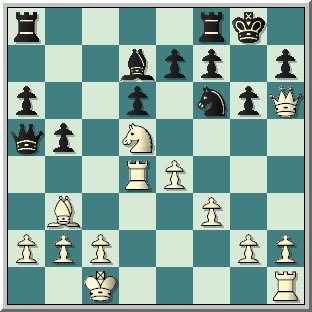
15... Qd8??
This was the deciding move. 15...Nxd5 was needed.
16. Nxf6+ exf6 17. e5! fxe5 18. Rh4 1-0
Ken Gurge contributed this game - a draw in a winning position! Would YOU have seen it?! (Additional Fritz analysis added by Dave Couture).
[Event "Demulling Memorial"]
[Site "Fitchburg, MA"]
[Date "2006.07.12"]
[Round "2"]
[White "Bruce Felton"]
[Black "Ken Gurge"]
[Result "1/2-1/2"]
[ECO "D04"]
[WhiteElo "1867"]
[BlackElo "1627"]
[PlyCount "73"]
1. d4 Nf6 2. Nf3 d5 3. e3 c5 4. c4 Bg4
The most popular moves here are 4... e6, dxc4, or cxd4.
5. Nc3 e6?!
Fritz prefers 5...cxd4 here giving the following line 6. exd4 Nc6 7. Be3 e6 8. c5 Ne4 9. Bd3 with equality.
6. Qa4+ Qd7 7. Ne5?!
Fritz prefers 7...Nb5 Nc6 8. Ne5 Qc8 9. Nxg4 Nxg4 10. cxd5 exd5 11. Be2 with a small edge for white.
7... Qxa4 8. Nxa4 cxd4 9. exd4 Bb4+ 10. Nc3 O-O?!
Again Fritz - the all knowing all seeing(?) - prefers 10...Nc6 11. Be3 dxc4 12. Bxc4 Bf5 13. Bb5 Rc8 14. a3 Bd6 15. Rc1 with equality.
11. a3 Bxc3+ 12. bxc3 Nbd7 13. Nxg4 Nxg4 14. cxd5 exd5 15. Be3?! Rfe8 16. Kd2 Nxe3 17. fxe3 Re7 18. Bd3 Nf6 19. h3 Rc8 20. Rac1 Ne4+ 21. Bxe4 dxe4 22. c4 Rec7 23. c5 b6 24. cxb6 axb6 25. Rxc7 Rxc7 26. Rc1?!
So far neither Bruce nor Ken has made any big, bad blunders, just a few dubious moves. Here Fritz prefers
26. Rb1 Rc6 27. Rb5 Rg6 28. g4 Kf8 29. Re5 Rh6 30. Rxe4 Rxh3 31. Re5 Rh4 32. Rb5 Rxg4 with a small advantage for white.
26...Rxc1 27. Kxc1 f5 28. Kd2 Kf7 29. g3 g5 30. a4?!
Fritz gives 30. h4 h6 31. hxg5 hxg5 32. Kc3 Ke6 33. Kc4 Kd6 34. a4 Kc6 35. Kb4 Kd5 36. Kc3 with equality.
30...Ke6
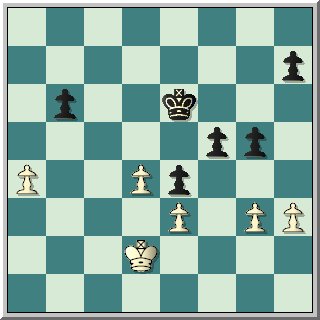
31. Kc3?
With this move Fritz gives black a winning advantage. To preserve winning chances Fritz gives 31. Kc2 Kd5 32. Kc3 h5 33. h4 g4 34. Kb3 f4 35. exf4 e3 36. Kc2 Ke4 37. Kd1 Kf3 38. Ke1 with a clear advantage for black.
31... Kd5 32. h4 gxh4 33. gxh4 h5
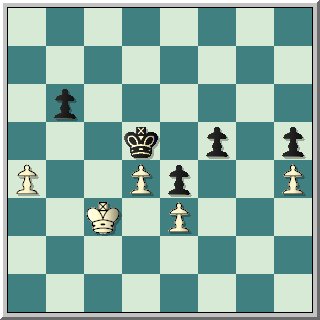
34. Kb3??
Again, to preserve ANY chance for a win, white needed to play
34.Kd2 Kc4 35.Ke1 Kb4 36.Kf2 Kxa4 37.Kg3 Kb5 38.Kf4 Kc4 39.Ke5 b5 40.d5 f4 41.d6 fxe3 42. d7 e2 43.d8Q e1Q
34...f4 1/2-1/2??
Here Ken offered Bruce a draw which Bruce accepted. Unfortunately for Ken he had a win! Ouch!
35. exf4 Kxd4 36. Kc2 e3 37. f5 Ke5 38. Kd3 Kxf5 39. Kxe3 Kg4 40. Ke4 Kxh4 41. Kf4 Kh3 42. Kf3 and here is the part that Ken, unsurprisingly, hadn't foreseen 14 moves ago(!), 42...h4! Now white is in zugzwang and is forced to step aside and let the black king escape, march to the other side of the board and win easily (while white has to delay to gobble the h-pawn).
The big question is, how many of US would have played on after 34...f4? It certainly looks like a draw to ME!
-Dave Couture
George Mirijanian contributed this game (additional comments by Dave Couture (DC)).
Here's my
second-round game against Martin.
Martin researched a game I had played against Ken Gurge - I don't know when that
was played - and found an improvement on the 6th move that gave him the
advantage. After misplaying the opening, I was lucky to draw the game in a
position in which Martin accepted my draw offer when he could find no clear win.
I have added some notes.
White: Martin Laine (1781)
Black: George Mirijanian (1947)
Vienna Game [C26]
Rd. 2, Wachusett CC Championship
May 17, 2006
1. e4
e5 2. Nc3 Nf6 3. Bc4 Bc5
[I was not in the mood to enter into the complications of the
Frankenstein-Dracula Variation after 3...Nxe4?! 4. Qh5! Nd6 5. Bb3 Nc6 6. Nb5 g6
7. Qf3 f5 8. Qd5 Qe7 9. Nxc7+ Kd8 10. Nxa8 b6 - a position that Martin and I
have reached more than once in the past.]
4. d3
d6 5. f4 Ng4?
[This is a mistake. Black was better off playing 5...Nc6 or 5...Bg4. Even
5...Be6!? was a viable continuation. But the text move gets Black into big
trouble.]
6. f5!
Nf2?
[Black is too greedy. But what he is supposed to do? On 6...h5 7. Nh3 Qh4+ 8.
Kf1 Be3 White continues with 9. Nd5! and is winning. And after 6...Qh4+ 7. g3
Qh5 8. h3! Bxg1 9. Qxg4 Qxg4 10. hxg4 Bb6 11. g5 Nc6 12. g6! fxg6 13. fxg6 h6
14. Rxh6! Rxh6 15. Bxh6 Ne7 16. Bf7+ Kf8 17. Bg5 Bg4 18. Kd2 Bh5 19. Rf1! and
Black should throw in the towel after 20. g4.]
7. Qh5
g6
[The alternatives were no better. On 7...0-0? would follow 8. Bg5 Qd7 9. Nd5!
and on 7...Qe7? would follow 8. Nd5 Qd7 9. Bh6!]
8. Qh6
Nxh1 9. Bg5! f6 10. fxg6
(DC) T Mazuchowski vs. M Bond (1992) continued 10. Qg7 Rf8 11. Nd5 Nd7 12. Qxh7 fxg5 13. Qxg6+ Rf7 14. Nxc7+ Qxc7 15. Qxf7+ Kd8 16. Qg8+ Ke7 17. Qxg5+ Ke8 18. Qg6+ Kd8 19. Qg8+ and white won in 28 moves.
10...fxg5 11. g7 Kd7! 12. Qe6+ Kc6 13. Qd5+
[Worthy of consideration was 13. Bb5+!? Kb6 14. Qb3 - with the devastating
threat of 15. Nd5+ - and if Black plays 14...c6 to find a hiding square on c7,
there could follow 15. Nd5+! cxd5 16. Be8+! followed by 17. gxh8Q. Even he tries
to find a hiding square on a7 with 14...a6, White just continues with 15. Be8+!
followed by 16. gxh8Q. But how does one assess this position after ...Bd7?]
13...Kd7
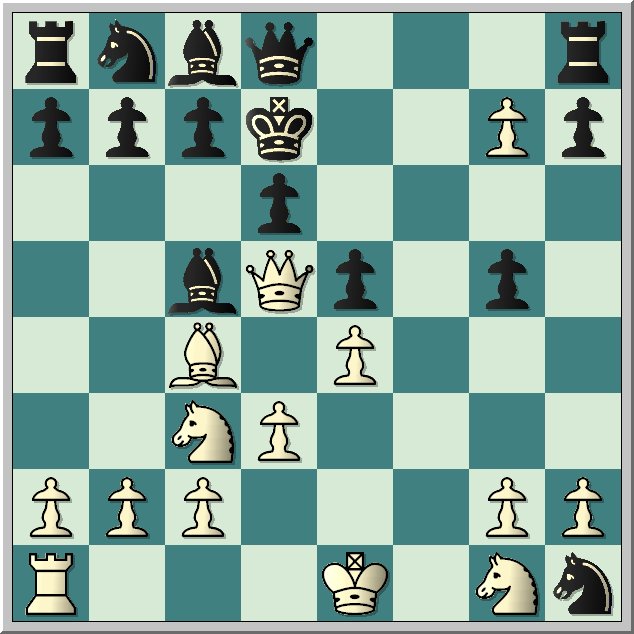
[With this move I offered Martin a draw, which he accepted. However, the game
would have been far from over had he played 14. Nf3!? with the threat of 15.
Nxe5+.]
(DC) Fritz gives white a winning advantage of 5.63 (e.g., 14.
Qf7+ Kc6 15. Bb5+ Kb6 16. Be8! Qxe8 17. Qb3+ Ka5 18. gxh8=Q Bd7 19. Qxb7 etc.
1/2-1/2
Notes by George Mirijanian
Here's my first-round game against Tom Fratturelli that should be of theoretical
interest as far as the opening is concerned. I have added a few notes.
White:
George Mirijanian (1947)
Black: Tom Fratturelli (1578)
Scandinavian Defense [B01]
Rd. 1, Wachusett CC Championship
May 10, 2006
1. e4
d5 2. exd5 Qxd5 3. Nc3 Qa5 4. d4 c6
(Black has to play this move sooner or later in order to give his queen an
escape route. But most players would probably wait until White has revealed his
plans. More usual is first 4...Nf6 and if 5. Nf3, then 5...c6 is OK or even
5...Bf5. For the bolder player, 4...e5?!, Anderssen's Variation, was an option.)
5. Nf3
Nf6 6. Bd2
(The only other sensible continuation was 6. Bc4.)
6...Qc7
(6...Qb6 could be met by 7. Bc4!, for if Black greedily grabs the pawn with
7...Qxb2?! he may get himself into trouble after 8. d5! Nbd7 9. 0-0 Nb6 10. dxc6
bxc6 11. Bb3 Qa3 12. Ne5 e6 13. Qf3, etc.)
7. Bc4
e6?!
(There was no need for Black to shut in his light-squared bishop with this move.
Perfectly OK was 7...Bf5 or even 7...Bg4.)
8. Qe2
(After this move, the position is the same as was seen in the game
Tal-Mascarinas, Lvov 1981, where Tal's opponent continued with 8...Be7 instead
of the move chosen by Fratturelli.)
8...Bd6 9. Ne5
(Also possible was 8. Ne4.)
9...0-0 10. 0-0-0 b5 11. Bd3 Nbd7 12. f4
(White could have been content with 12. Rhe1, but he has other ideas.)
12...b4 13. Ne4 a5 14. g4 c5 15. g5 Nd5 16. Nxd6 Qxd6 17. Qh5 f5?!
(17...g6 was better.)
18.
g6! N7f6?
(18...h6 was still possible.)
19.
gxh7+ Nxh7 20. Rhg1 Ra7 21. Rg3 Ndf6 22. Qe2 cxd4 23. Rdg1 Re7??
(An oversight that ultimately costs Black the game. Called for was either
23...Rc7 or 23...a5 with counterplay on the queen flank.)
24.
Ng6 Rff7 25. Nxe7 Rxe7 26. Re1 Bb7?
(Called for was 26...Rc7.)
27.
Bxf5 Rc7 28. Qxe6+ and Black resigned. (1-0)
George M
Notes by George Mirijanian
White:
George Mirijanian (1955)
Black: Alan Condon (1454)
Barnes Defense [B00]
Rd. 5, WCC Championship Prelims
May 3, 2006
1.
e4 e6 2. d4 f6?!
[This is
a highly unusual defense. It is known as the Barnes Defense, since Thomas Wilson
Barnes (1825-1874), one of the strongest players in England during the 1850s,
used it to defeat Paul Morphy in a friendly game in London in July 1858. When
Barnes tried this defense against Adolf Anderssen - in the London International
Tournament in June 1862 - he lost. Barnes is remembered for having scored more
wins than anyone else in casual games against Morphy in 1858. He met with a
tragic end. He went on a diet, lost 130 pounds in 10 months, and died as a
result. In both games that Barnes played his defense, he met 1. e4 with 1...f6,
but after 2. d4 played 2...e6, bringing about the position that was reached in
the Mirijanian-Condon game.]
3. Nf3
b6
[Barnes'
plan was to play 3...Ne7 and follow it up with ...d5.]
4. Bd3
Ba6 5. c4 Bb4+ 6. Nc3 d5??
[Called
for was 6...Ne7.]
7.
exd5?
[7. Qa4+
simply won a piece.]
7...exd5??
[Correct
was 7...Bxc3+.]
8.
0-0?
[Once
again, 8. Qa4+ gained White a piece.]
8...Bxc3 9. bxc3 Bxc4 10. Bxc4 dxc4 11. Qa4+ Qd7 12. Qxc4 Nc6 13. Re1+ Nce7?
[Correct
was 13...Nge7.]
14.
Ba3 Kd8?
[It was
best for Black to play 14...0-0-0! and not fear 15. Qa6+.]
15.
Qf7 Nd5??
[Correct
was 15...Ng6! and it looks like all White gains is a pawn following 16. Re8+!
Qxe8 17. Qd5+ Qd7 18. Qxa8+ Qc8 19. Qxa7.]
16.
Qf8+
and
Black resigned.
(1-0)
George M
[Event "06 WCC Chmp. Prelims"]
[Site "Fitchburg"]
[Date "2006.04.12"]
[Round "2"]
[White "George Mirijanian"]
[Black "Ken Gurge"]
[Result "1/2-1/2"]
[ECO "B02"]
[WhiteElo "1955"]
[BlackElo "1596"]
[Annotator "Gurge,Ken"]
[PlyCount "148"]
[TimeControl "300+3"]
{75MB, Fritz9.ctg, DELL}
1. e4 Nf6 2. Bc4 d5 3. exd5 Nxd5
{last book move} 4. Nf3 Bg4 5. h3
Bh5 6. d4 e6 7. Be2 Bb4+ 8. c3 Be7 9. O-O O-O 10. Re1 a6 11. c4 Nf6 12. Nc3 Re8
13. Be3 Nbd7 14. Ne5 Bxe2 15. Qxe2 Nb6 16. a3 c6 17. Rad1 Qc7 18. Bf4 Nbd7 19.
Qf3 Bd6 20. g4 h6
({1.38 Fritz 9:} 20... Red8 21. b4 a5 22. g5 Ne8 23. Nxf7 Bxf4 {[eval 59,14]})
21. h4 Nh7 22. Ne4 Nxe5 23. dxe5
Bxe5 24. Bxe5 Qxe5 25. Nd6 Qf6 26. Qxf6 Nxf6 27. Nxe8 Rxe8 28. f3 g6 29. Kg2 Kf8
30. Kg3 Ke7 31. Rd2 Rd8 32. Red1 Rxd2 33. Rxd2 Nd7 34. f4 f6 35. b4 b6 36. a4
Nb8
({1.71 Fritz 9:} 36... a5 37. b5 cxb5 38. axb5 Nc5 39. Kf3 g5 40. fxg5 fxg5 41.
h5 a4 42. Ke3 {[eval 113,16]})
37. Kf3 Nd7 38. Ke3 e5 39. g5
({1.09 Fritz 9:} 39. f5 gxf5 40. gxf5 a5 41. b5 cxb5 42. axb5 h5 43. Rg2 Kd6 44.
Rg8 {
[eval 168,16]})
39... exf4+ 40. Kxf4 hxg5+ 41. hxg5
f5
({1.73 Fritz 9:} 41...fxg5+ 42. Kxg5 a5 43. Re2+ Kd6 44. b5 cxb5 45. Rd2+ Ke7 {[eval 109,17]})
42. Re2+ Kf7 43. a5 bxa5 44. bxa5
Nc5 45. Ke5 Ne4
({2.61 Fritz 9:} 45... Ke7 46. Rh2 Nd7+ 47. Kd4 Kd6 48. Rh8 Nc5 49. Rd8+ Kc7 50.
Ra8 Kd6 51. Ke3 Ne6 {
[eval 144,19]})
46. Rb2 Ke7
({3.92 Fritz 9:} 46... Nxg5 {[eval 234,18]})
47. Rb7+ Kd8 48. Rg7 Nxg5 49. Rxg6
Nf3+ 50. Kd6 Ke8 51. Rg3 Nd2 52. Ke6 Kf8 53. Kxf5
({0.79 Fritz 9:} 53. Rg5 {[eval 326,19]})
53... Nxc4 54. Rc3 Nxa5 55. Kf6 Ke8
56. Rc5 Nb7 57. Rxc6 Kd7 58. Rxa6 Nc5 59. Ra7+ Kd6 60. Ra8 Nd7+ 61. Kf5 Ke7 62.
Ra7 Kd6 63. Ra6+ Kd5 64. Ra1 Nc5 65. Rd1+ Kc4 66. Ke5 Nd3+ 67. Ke6 Nf4+ 68. Kd6
Nd3 69. Rh1 Kd4 70. Rh3 Nf4 71. Rg3 Ke4 72. Rg5 Kd4 73. Re5 Nd3 74. Rh5 Nf4
1/2-1/2
Probably my biggest enemy during this game was my old nemesis, THE CLOCK! All credit goes to Richard for playing as well as he did while using MUCH less time than me.
[Event "2006 WCC Championship Prelims"]
[Site "Fitchburg"]
[Date "2006.04.05"]
[Round "1"]
[White "Richard Bennett"]
[Black "Dave Couture"]
[Result "1-0"]
[ECO "A00"]
[WhiteElo "1294"]
[BlackElo "1617"]
[PlyCount "101"]
[TimeControl "40/80:SD/30"]
1. h4!?
This is my 140th tournament game as black and the first time I've seen this! No one was even sure of the name. George Mirijanian thought it was called the "Meadow Hay", but that is actually the name given to a4. I had to look it up and found that the actual names for this h4 opening are the Desprez or the Kadas Opening.
1...e5 2. h5 d5 3. d4 exd4 4. Nf3
I don't think the sacrifice is justified given that I've already developed to d5 so I decide to hang on to the extra pawn.
4...c5 5. c3 dxc3 6. Nxc3 Be6 7. e3 Nc6 8. Bb5 Nge7 9. b3 Qb6 10. Bxc6+ Qxc6 11. a4 Nf5 12. Ne5 Qd6 13. f4?
Unnecessarily opens up the kingside. 13. Nd3 would have been better.
13...Be7 14. Qf3?
14. g4 kicking the knight would have prevented my next move.
14...Bh4+ 15. Kd2 d4 16. Nb5 dxe3+ 17. Kc2 Qe7 18. Kb2 Bf6 19. Bxe3 O-O 20. Rad1 Rfd8 21. Rxd8+ Qxd8 22. Bxc5 Qd2+
At this point I'm already down to 24 minutes left for my next 18 moves.
23. Ka3 Bd5??
Shortly after I made my move, I saw his response and hoped he wouldn't see it.
24. Rd1!
No such luck. A nice move on his Richard's part. What I needed to do on my 23rd move was something along the lines of Rc8 or Rd8 to really keep the pressure on.
24...Bxf3 25. Rxd2 Bxh5 26. Bxa7
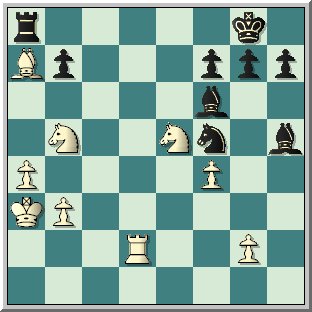
26...Be7+ 27. Ka2?!
A little too tentative. I think 27. b4 is better.
27...f6 28. Nc4 Rd8 29. Rxd8+ Bxd8 30. Ncd6 Ne3??
Hey what's that piece he's picking up over near my right elbow?!! As he lifted my knight off the board I closed my eyes and said "Oh God!" loudly enough to disrupt everyone who was still playing - my apologies.
31. Bxe3 b6 32. Nb7 Be7 33. Bxb6 Be8 34. Nc7?
He let's me back into the game just a little bit...
34...Bc6 35. Nc5 Bxg2 36. a5 h5 37. N7e6 h4 38. f5 h3??
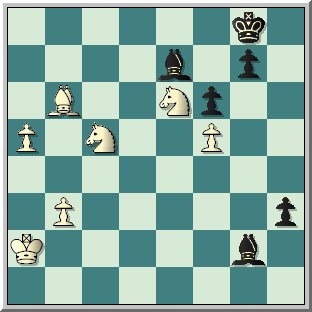
These last few moves I was thinking that he had blown the endgame and I was marching on to a comeback victory. If I had been paying attention and foreseen his next move, I could have just played 38...Bd6!
39. Bc7 Kf7 40. Nd3?? Be4 41. Nf2??
41. Nec5 leads to victory.
41...Bxf5 42. Nd8+?
Nd4 is better here.
42...Ke8 43. Nb7 Be6??
George Mirijanian pointed out that Kd7 was needed here. I would probably end up with a draw, whereas my move would have thrown the game away if he had played 44. a6, but...
44. Nd3?? Kd7 45. Bh2 g5??
Again it was George who pointed out that I had a "must-play" move here - Kc6!
46. Kb2??
Richard could have put the nail in the coffin here with Nbc5+.
46...Bd5 47. Nbc5+ Kc6 48. b4 f5 49. Ka3?!
I'm pretty sure Kc2 is better, but I'll leave that as an exercise for you Dear Reader so you can get an idea as to how complex this endgame is (you're welcome).
49...f4?
With not a lot of time left on my clock, and trying to decide between f4 and Kb5 I decide to go for broke and make the wrong choice.
50. Ka4 f3??
Continuing on the "going for broke" theme. Pretty much as soon as I made the move, I realized that his obvious next move was now going to be mate and I didn't have much hope that he would suddenly decide to do something OTHER than make the move he had been planning to make anyway...
51. b5# 1-0
Excellent game Richard! May we meet again in the championship round.
[Event "Dr. Max Levinger Memorial"]
[Site "Fitchburg"]
[Date "2006.03.29"]
[Round "5"]
[White "Ken Gurge"]
[Black "Bruce Felton"]
[Result "0-1"]
[ECO "B90"]
[WhiteElo "1637"]
[BlackElo "1845"]
[Annotator "Gurge,Ken"]
[PlyCount "88"]
[TimeControl "300+3"]
{75MB, Fritz9.ctg, DELL}
Note from Ken Gurge:
Here is another game for the website. It's from last week and the result gave Bruce a share of 1st for the tournament. It's interesting because Bruce plays the dragon rather than his usual hybrid Schevenigan/Najdorf (which I had studied for!). Despite dropping a pawn early, I came up with an exchange sacrifice on move 21 which should have led to at least equality had I followed up with Qh6 after the first check, rather than Qg3+. After Qh6 it seems black must allow a perpetual check or allow white to achieve essential material equality with potential winning chances if black tries too hard for the win. The evaluation is by Fritz 9 which gives 0.00 after the Qh6 line.
1. e4 c5 2. Nf3 d6 3. d4 cxd4 4. Nxd4 Nf6 5. Nc3 a6 6. a4 Nc6 7. Be2 Bd7 8. O-O g6 9. Be3 Bg7 10. f4 O-O {last book move}
11. Qd2 Rc8 12. f5 Ne5 13. Nd5 ({-0.39 Fritz 9:} 13. a5 Nc4 14. Bxc4 Rxc4 15. fxg6 fxg6 16. Nb3 Qc7 17. Qd3 {[eval 25,13]})
13... Nxe4 14. Qd1 ({-1.46 Fritz 9:} 14. Qb4 gxf5 15. Nxf5 Bxf5 16. Rxf5 e6 17. Qxe4 exf5 18. Qxf5 Kh8 19. Rf1 {[eval -39,14]})
14... Nf6 ({-0.66 Fritz 9:} 14... gxf5 15. a5 e6 16. Nb6 Rc7 17. c3 Kh8 18. Qb3 {[eval -146,14]})
15. Nxf6+ Bxf6 16. Kh1 ({-1.35 Fritz 9:} 16. c3 Nc4 17. Bh6 Re8 18. fxg6 hxg6 19. Bxc4 Rxc4 20. a5 {[eval -67,13]})
16... Nc6 ({-0.60 Fritz 9:} 16... Nc4 17. Bxc4 Rxc4 18. c3 Qc7 19. Bh6 Rc8 {[eval -135,13]})
17. fxg6 hxg6 18. Qd2 ({-1.53 Fritz 9:} 18. c3 Kg7 19. Nxc6 Bxc6 20. Bg4 e6 21. Bf4 Be5 22. Bxe5+ {[eval -62,13]})
18... Bxd4 19. Bxd4 Nxd4 20. Qxd4 Bf5 ({0.00 Fritz 9:} 20... Rxc2 21. Bd1 Rc7 22. Ra3 Bc8 23. Qd2 Kg7 24. a5 Rh8 25. Be2 {[eval -148,15]})
21. Rxf5 gxf5 22. Qh4 e5 23. Qg3+ ({-1.44 Fritz 9:} 23. Qh6 Re8 24. Ra3 Re6 25. Rg3+ Rg6 26. Rxg6+ fxg6 27. Qxg6+ Kf8 28. Qxf5+ {[eval 0,15]})
23... Kh7 24. Qh3+ Kg6 25. Rf1 Qg5 26. g4 ({-3.73 Fritz 9:} 26. Qd3 {[eval -201,13]})
26... f4 27. Qd3+ Kg7 28. Rf3 Rcd8 29. Rh3 Rh8 30. Rxh8 Kxh8 31. Qd5 ({-5.11 Fritz 9:} 31. c4 Qh4 32. Kg2 Kg7 33. Qc3 Re8 34. Bf3 {[eval -356,14]})
31... Rd7 32. c4 Qg6 33. Qd1 e4 34. Qd4+ Kg8 35. h3 ({-7.50 Fritz 9:} 35. Kg2 {[eval -555,14]})
35... f3 36. Bd1 Re7 37. Qe3 Qf6 38. b3 ({-#17 Fritz 9:} 38. Qf2 Qf4 39. Kg1 d5 40. b4 dxc4 41. b5 {[eval -831,14]})
38... Kf8 ({-9.18 Fritz 9:} 38... f2 39. a5 f1=Q+ {[eval -32750,12]})
39. Kg1 Ke8 40. Kf1 Qb2 41. Qf2 Qxf2+ ({-5.45 Fritz 9:} 41... Qa1 {[eval -823,15]})
42. Kxf2 Kf8 43. Bc2 ({-#13 Fritz 9:} 43. Ke3 Re6 44. h4 Rf6 45. Kxe4 f2 46. Be2 f1=Q 47. Bxf1 Rxf1 48. h5 Kg7 49. Kd5 Rd1+ 50. Ke4 Rg1 {[eval -466,17]})
43... e3+ 44. Ke1 e2 0-1
[Event "Dr. Max Levinger Memorial"]
[Site "Fitchburg, MA"]
[Date "2006.03.22"]
[Round "4"]
[White "Martin Laine"]
[Black "Dave Couture"]
[Result "1-0"]
[ECO "B01"]
[WhiteElo "1741"]
[BlackElo "1617"]
[PlyCount "139"]
1. e4 d5 2. exd5 Qxd5 3. Nc3 Qa5 4. d4 Nf6 5. Nf3 c6 6. Bc4 Bf5 7. Bd2 e6 8. Qe2 Bb4 9. O-O-O Nd5
A previous game between us had continued 8... Nbd7 9. O-O-O Bb4 10. Nh4 and ended in a 48 move draw. Perhaps I should reconsider 8...Bb4 or 9...Nd5.
10. Nxd5 Bxd2+ 11. Rxd2 cxd5 12. Bb5+ Nc6 13. a3 O-O 14. Bxc6 bxc6 15. Ne5 Qc7 16. g4 Bg6 17. h4 f6 18. Nxg6 hxg6 19. Qxe6+ Kh7 20. g5 Rae8 21. Qh3 Qf4 22. Qg3 Re4 23. c3 Rfe8 24. Qxf4 Rxf4 25. gxf6 gxf6 26. Kd1 Rfe4 27. Rh3 Kh6 28. f3 Re1+ 29. Kc2 R8e3 30. Rg2 R1e2+ 31. Rxe2 Rxe2+ 32. Kb3 f5 33. a4 a5 34. Ka3 f4 35. b4 Re1
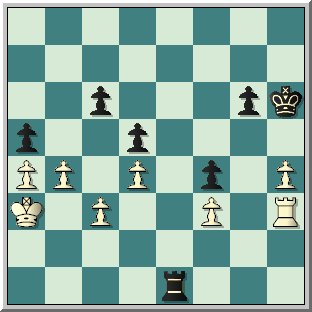
36. bxa5 Rb1 37. a6 Rb6 38. a5 Rxa6 39. Kb4 Ra8 40. Rh2 Rb8+ 41. Ka3 Rb5 42. Ka4 Kh5 43. Rg2 Rb1 44. Rg4 Ra1+ 45. Kb4 Rb1+ 46. Kc5 Rb5+ 47. Kxc6 Rxa5 48. Rxf4 Ra3 49. Kxd5 Rxc3 50. Kd6 g5 51. hxg5 Kxg5 52. Ke5 Re3+ 53. Re4 Rxf3 54. d5 Rf5+ 55. Kd6 Kf6 56. Kc6 Rf1 57. d6 Rc1+ 58. Kd7 Ra1
After this move I had less than 5 minutes left on my clock and I believe Martin had about 40 minutes. Okay, so he manages his time a little better than I do.
59. Re6+ Kf7 60. Re7+ Kf8 61. Re5 Ra7+ 62. Ke6??
Martin finally gives me a chance to get my king in front of the pawn and draw with 62...Ke8, but with my time running down I miss it and play
62...Ra6?? 63. Rc5 Ra8 64. Rh5 Re8+ 65. Kf6 Kg8 66. Rd5 Rf8+ 67. Ke6 Re8+ 68. Kd7 Rf8 69. Kc7 Rf7+ 70. d7 1-0
All of my games with Martin have been enjoyable and hard-fought. After this game, my lifetime record against him is a dead-even 1 win, 1 loss, and 2 draws!
[Event "Dr. Max Levinger Memorial"]
[Site "Fitchburg"]
[Date "2006.03.15"]
[Round "3"]
[White "Ken Gurge"]
[Black "Paul Giovino"]
[Result "1-0"]
[ECO "C70"]
[WhiteElo "1637"]
[BlackElo "1747"]
[PlyCount "77"]
1. e4 e5 2. Nf3 Nc6 3. Bb5 a6 4. Ba4 b5 5.
Bb3 Bc5 6. O-O d6 7. h3 Nge7 8. c3 Ng6 9. d3 O-O 10. Re1 Be6 11. Nbd2 d5 12. Nf1
Re8 13. Ng5 Qf6 14. Qd2 Nf4 15. Nxe6 fxe6 16. d4 Bd6 17. dxe5 Bxe5 18. exd5 Nxd5
19. Bxd5 exd5 20. Qxd5+
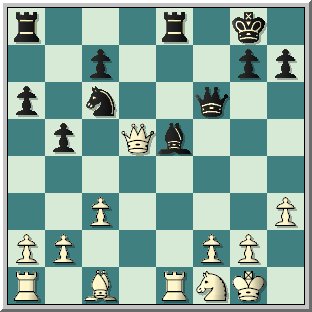
20...Kh8 21. Be3 Rad8 22. Qb3 Rf8 23. Rad1 Rxd1 24. Rxd1 Na5 25. Qc2 Nc4 26. Bd4 Bxd4 27. Rxd4 Ne5 28. Nh2 Qg5 29. Qd2 Qg6 30. Rd8 Qb1+ 31. Qd1 Qxd1+ 32. Rxd1 h6 33. b3 c5 34. Rd5 Rf5 35. c4 bxc4 36. bxc4 Rg5 37. f4 Rxg2+ 38. Kxg2 Nxc4 39. Rxc5 1-0
2005 Games
Notes by George Mirijanian
Additional
comments by Dave Couture (DC) using Fritz 8 for analysis.
White: George Mirijanian (1959)
Black: Bruce Felton (1886)
[B12] Caro-Kann Defense
Round 4, December 21, 2005
1. e4 c6!
The first surprise of
the game. I had expected Bruce to play his trusty Sicilian, but perhaps he
feared I had something special planned against his 1... c5. But I didn't.
2. d4 d5 3. f3!?
This is the
characteristic move of the Tartakower Variation, better known as the Fantasy
Variation. It was favored by Saviely Tartakower (1887-1956), who was known for
off-beat variations.
3... e6
Evidently, Bruce did
not relish playing 3...dxe4 4. fxe4 e5!, since after 5. Nf3 Black has nothing
better than 5...Be6! because 5...exd4? allows 6. Bc4! and gives White the
advantage. Now Black threatens 4...dxe4 5. fxe4 Qh4+, gaining him the advantage.
4. e5?!
This is not the normal
move. More sensible was 4. Nc3, as was played in the game Smyslov-Botvinnik,
World Championship Match, Moscow 1958. Also possible was 4. Be3, which offers a
gambit after 4...dxe4? 5. Nd2! and now 5...exf3?! gives White rapid development
of his pieces following 6. Ngxf3 Nf6 7. Nc4. Better after 4. Be3 would be 4...
Qb6!
4... c5 5. c3 Nc6
The position has the
looks of the French Defense, which it is, after the loss of tempi by both sides.
Theory views this as favorable to Black.
6. f4 cxd4 7. cxd4 Bb4+ 8. Nc3 Nge7 9. Nf3
a6 10. Bd3 Bd7 11. 0-0 b5 12. Ne2 Ba5 13. Kh1 Bb6 14. Be3 Na5?! 15. b3 Rc8 16.
Rc1 Rxc1 17. Bxc1 Qc8 18. Bd2
Worthy of consideration
was 18. Ba3!? ((DC)Fritz 8 confirms that Ba3 is better.)
18... g6?!
(DC)Fritz 8 gives 18...Nac6 followed by Nf5 as better.
19. Qe1 Nac6
20. Qh4 Ng8 21. Rc1 Qd8 22. Qh3 Qe7 23. g4 Qf8?!
Worth considering was
23...Qa3!?
24. f5 Qg7 25. fxe6 fxe6 26. a4 Nd8? 27.
a5?
(DC)Fritz 8 shows that both sides miss the threat of 27. axb5 axb5 28. Nc3 followed by 29. Nxb5.
27... Ba7 28. Rf1?! Nf7 29. Rc1??
(DC)White misses the chance to end the game by attacking immediately with 29. Ng5!, but now with...
29... Ne7?
(DC)Black misses the defensive opportunity Nd8!
30. Qh4 Nc6 31. Kg2 h5
(DC) Fritz 8 gives 31... O-O as better.
32. g5 Bb8 33. Qg3
(DC) Now we move into the land of missed attacking opportunities that only Fritz and MAYBE Kasparov would see. Observe: White could have played 33. Nf4! Ne7 34. Bb4 Rg8 35. Bxe7 Kxe7 36. Nxg6+ Ke8 37. Nf4 Bxe5 (what else? 37... Rh8 38. g6 Nd8 39. Nxh5 and now Black has to play 39... Rxh5 because the queen has no safe place to go.) 38. Nxh5 Qh6 39. dxe5 Nxe5 40. Kf1 Nxf3 41. gxh6 Nxh4 42. Nf6+ Kf7 43. Nxg8 Kxg8 and White is going to win the bishop and be up a full rook.
33... Bc7??
(DC) Black misses his chance to stay somewhat in the game with 33... h4.
34. Nh4 Bxa5 35. Be3?
(DC) White misses his chance to put the game away with 35. Bxa5 Nxa5 36. Bxg6 and then Nf4.
35... Ne7 36. Nf4 Nf5?
(DC) Fritz 8 gives 36... Bd8 as better.
37. Nxf5 gxf5 38. h4 Bd8 39. Bxf5?
(DC) Fritz 8 gives 39. Be2 as better.
39... exf5 40. e6 Bxe6??
(DC) 40... Nd6 41. exd7+ Qxd7 would have left Black with a tough, but still tenable position.
41. Nxe6
Qf8??
A "fingerfehler" in the
immediate aftermath of mutual time trouble. Bruce let go of his queen and
realized, to his horror, what he had done. He stared a long time at the position
and both players knew that the game was over without either one saying a word.
1-0
Even if the queen had moved to a "safe" square, like 41...Qg6, White wins after 42. Nxd8 Kxd8 [42...Nxd8?? 43. Qe5+ and 44. Qxh8] 43. Qb8+ Ke7 44. Rc7+, etc.
Notes by Dave Couture.
Analysis by Fritz 8.
[Event "George Sturgis Memorial"]
[Site "Fitchburg, MA"]
[Date "2005.12.21"]
[Round "4"]
[White "George O'Rourke"]
[Black "Dave Couture"]
[Result "1-0"]
[ECO "B01"]
[WhiteElo "1834"]
[BlackElo "1553"]
[PlyCount "113"]
1. e4 d5 2. exd5 Qxd5 3. Nc3 Qa5 4.
g3
George's favorite anti-Scandinavian weapon!
4...g6 5. Bg2 Bg7 6. Nge2 Nf6 7. d3 c6 8. Bd2 Bg4 9. h3 Be6 10. O-O O-O 11. Nf4 Bd7 12. Re1 Re8 13. Ncd5 Qd8 14. Ne3 Na6 15. Nc4 Nc7 16. Ne5 Nfd5 17. c3 Nxf4 18. Bxf4 Be6 19. d4 Nd5 20. Qd2 Nxf4 21. Qxf4 f6?
Just 21...Qd6 would have been good enough for rough equality.
22. Nxg6!
My first reaction when George played this was "Shoot! (or words to that effect!) I've lost a pawn - I should have seen that tactic! Then I realized (mistakenly) that I could get away with getting my bishop out of the line of fire by just recapturing his pawn on h3.
22...Bxh3?? 23. Nh4??
Luckily George misses the same thing that I missed: 23. Bxh3! e5 24. dxe5 hxg6 25. Rad1 Qe7 26. Qc4+ Kh7 27. Rd7 and the Rook on the e-file is coming over to the h-file next. I'm not sure if I should give these moves double question-marks. Just because Fritz sees this stuff doesn't necessarily mean that us mere mortals should see it!
23...Bxg2 24. Kxg2 Qd5+ 25. Qe4 Qxe4+ 26. Rxe4 e5?!
26...e6 is better.
27. Rae1 Kf7 28. Nf5 Rad8 29. Nxg7 Kxg7 30. f4 Kf7 31. fxe5 fxe5 32. Rxe5 Rxe5 33. Rxe5 Kf6 34. g4 h6 35. Kf3 Rd7 36. Kf4 Rg7 37. Rf5+ Ke6 38. Rh5 Rh7 39. Ke4 Kd6 40. b3 Re7+ 41. Kd3 Re6 42. c4 b6 43. Rf5
I was worried about George getting his Rook down to the first or second rank, so... clever me, I blocked that possibility with my King...
43...Ke7??
44. Re5
I'm still not sure whether or not George punched me in the gut after he made this move, but it certainly felt like it! If I had played something like 43...Rg6, I think that, at least theoretically, it's not clear whether this is a win for White or a draw. Given the 300 point rating difference, and the fact that I was woefully short on time, the reality is that I probably would have just lost further on down the line - truly PRACTICAL analysis!
44...Rxe5 45. dxe5 Ke6 46. Ke4 b5 47. a3 a5 48. a4 bxa4 49. bxa4 c5 50. Kf4 Ke7 51. Kf5 Kf7 52. e6+ Kg7 53. Ke5 Kg6 54. Kd6 Kf6 55. e7 Kg5 56. e8=Q Kxg4 57. Qg6+ 1-0
Notes by George Mirijanian.
White:
George Mirijanian (1954)
Black: George O'Rourke (1831)
[B76] Sicilian Defense
Round 5, Nov. 16, 2005
1. e4
c5 2. Nf3 d6 3. d4 cxd4 4. Nxd4 Nf6 5. Nc3 g6 6. Be3 Bg7 7. f3 0-0 8. Qd2 Nc6
9. 0-0-0
When playing the Yugoslav Attack against the Dragon Variation, another option
was to first employ 9. Bc4 before castling queenside and then start the kingside
attack with the g- and h-pawns.
9...a6
Black
had choices, too. Possible was 9...d5 and after 10. exd5 Nxd5 11. Nxc6 bxc6 12.
Bd4 Nxc3 13. Qxc3 Bh6+ 14. Be3 Bxe3+ 15. Qxe3 Qb6 Black stands OK, as was played
in Kasparov-Topalov, Amsterdam 1995.
10.
Nxc6?!
It was
probably more prudent to keep the b-file closed and opt for something like 10.
Kb1, as was played in the game Rossolimo-L. Evans, Havana 1952. Even 10. g4! had
more merit than the text move.
10...bxc6 11. e5 Nd5 12. Nxd5 cxd5 13. exd6 Rb8 14. c3 e6! 15. Bc5?! Bd7 16. Ba3
Qb6 17. Kb1 Rfc8 18. Ka1 Be5 19. f4?
Called
for was 19. h4! with the threat of 20. h5.
19...Bxd6 20. Bxd6 Qxd6 21. c4?!
Again,
21. h4 had to be played.
21...Qb6 22. cxd5 exd5 23. Bd3 Qf6! 24. Bb1?
Worthy of consideration was 24. f5!?
24...Rc4! 25. g3 Rcb4 26. Qc3 d4 27. Qa3 Qb6
Also
possible was 27...Rxb2.
28.
Rd2 Ra4 29. Qe7 Be6 30. f5??
White's
last-ditch effort should have been with 30. a3.
30...Bxa2! 31. Bxa2 Qb3 0-1
Notes by George Mirijanian.
White:
Martin Laine (1754)
Black: George Mirijanian (1945)
[A01] Nimzovich-Larsen Attack
Round 5, Oct. 5, 2005
1. b3 e5 2. Bb2 Nc6 3. e3 Nf6
Also good was 3...d5 and after 4. Bb5, then 4...Bd6, as was played in the game
Rizzitano-Curdo, 1978.
4. Bb5 d6 5. Ne2 Be7 6. 0-0 0-0 7. d4
GM Bent Larsen, after whom the variation is co-named, has favored 7. f4, but
after 7...e4 8. Ng3 Bg4 9. Be2 Bxe2 10. Qxe2 Re8 the position is roughly equal.
7...exd4 8. Nxd4 Nxd4 9. Qxd4 c6 10. Bd3 Ne8 11. Qe4 f5 12.
Qf3 g6 13. c4 Bf6 14. Nc3 Qe7 15. Rab1 Qg7 16. Na4 Be6 17. Qe2 Qh6 18. f4 Bxb2
19. Nxb2 Nf6 20. Nd1 d5 21. Nc3 Rfe8 22. h3 Rad8 23. cxd5 Nxd5 24. Nxd5 Bxd5 25.
Bc4 Qf8 26. Bxd5+ Rxd5 27. Rbd1 Qc5 28. Rxd5 cxd5! 29. Kf2 d4 30. Qc4+ Qxc4 31.
bxc4 dxe3+ 32. Ke2 Kf7 33. Rc1?!
Better was 33. Rd1.
33...Re4 34. g3 Ke8 35. Rc3 Kd7 36. Rxe3 Rxc4 37. Kd3 Ra4 0-1
Notes by Dave Couture.
[Event "Ed Wheeler Memorial"]
[Site "Fitchburg, MA"]
[Date "2005.11.09"]
[Round "4"]
[White "Martin Laine"]
[Black "Dave Couture"]
[Result "1/2-1/2"]
[ECO "B01"]
[WhiteElo "1730"]
[BlackElo "1553"]
1. e4 d5 2. exd5 Qxd5 3. Nc3 Qa5 4.
d4 Nf6 5. Nf3 c6 6. Bc4 Bf5 7. Bd2 e6 8. Qe2 Nbd7
8...Bb4 is usually played here.
9. O-O-O Bb4 10. Nh4 O-O-O 11.Nxf5 Qxf5 12. Bd3 Qg4 13. Qxg4 Nxg4 14. Rdf1 Ngf6 15. a3 Ba5 16. Ne4 Bxd2+ 17. Nxd2 Nd5 18. g3 e5?
This move allows 19. Nc4 attacking the e-pawn and threatening 20. Nd6+ followed by 21. Nxf7, forking the rooks. A better move would have been 18...N5f6 and I would have answered 19. Nc4 with Rhf8.
19. dxe5 Nxe5 20. Bf5+ Kc7 21. Re1 f6 22. f4 Ng6 23. Bxg6 hxg6 24. c4 Nb6 25. Re2 Rhe8 26. Rhe1 Rxe2 27. Rxe2 Rd7 28. b3 Nc8 29. Kc2 Re7 30. Re4 c5 31. Kd3 Rd7+ 32. Kc3 Nd6 33. Re6 Nf5 34. Nf3 Rd1 35. g4 Nd4 36. Nxd4 Rxd4 37. Re7+ Rd7 38. Rxd7+ Kxd7 39. h4 Kd6 40. Kd3 Ke6 41. b4 cxb4 42. axb4 f5 43. g5 Kd6 44. Kd4 b6??
This loses against correct play (see notes below). Instead 44...a6 is a draw.
45. b5 Ke6 46. c5 bxc5+ 47. Kxc5 Kd7 48. Kd5 Kc7 1/2-1/2
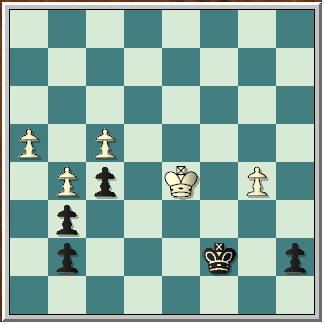
Martin offered a draw here and I accepted. I
thought a draw was the best he could do because I had looked at 49. Ke6 Kb6 50.
Kf7 Kxb5 51. Kxg7 a5 52. Kxg6 a4 53. h5 a3 54. h6 a2 55. h7 a1=Q winning.
I hadn't seen the possibility of 51. Kxg6! which would have been a win for
white: 51...a5 52. h5 a4 53. h6 a3 54. hxg7! a2 55. g8=Q a1=Q 56. Qd5+ Kb4 57.
Qxf5. Martin had seen this continuation, but didn't trust that he had
calculated correctly and realized a miscalculation could have resulted in a loss
for him. After 3 1/2 hours of play it's not unreasonable to mistrust
calculations 9 moves ahead!
2005 Wheeler Memorial Tournament
Third Round
November 3, 2005
Ken Gurge (1593) v. George Mirijanian (1959)
Bishop's Opening - Blanel Gambit (C27)
(Result 1-0)
(Annotations by Ken Gurge. Additional annotations by Dave Couture/Fritz 8.)
1.e4, Nf6 2. Bc4, e5 3.Nc3, Nxe4 (Nc6 is the move most often played here. - DC) 4. Bxf7+, Kxf7 5. Nxe4, d5 6. Ng3, Qf6 (more typical is Nc6 and 7.d3 as in Hua-Vladimirov, 2004 and Barber-Hausner, 2001) 7. Qf3, e4?? (likely the losing move, significant material loss can't be avoided after this) 8. Qh5+, g6
9. Qxd5+, Be6? (Pretty much throws away any chance for black. 9...Qe6 keeps black in the game, definitely at a disadvantage, but still in the game. - DC) 10. Qxb7, Nd7 11. Qxe4 (Qxa1!? leads to interesting complications but gives Black more counterplay for his material deficit), Bc5 12. Qf3 (up material White forces Queens off), Rhe8 13. Qxf6+, Nxf6 14. N1e2, h5 15. d3, Bd5 (Continuing the idea of the previous move with an immediate h4 would have been better. - DC)
16. f3 (the e4 square continues to be the focal point of the game and White intends to make it the strong point of his defense against Black's counterplay), h4 17. Ne4, Bb6 18. N2c3, h3 19. g3, Bc6
20. Bd2, Bd4 21. 0-0-0 (finally the King escapes the e file), Rab8 22. b3, a5 23. Nxf6 (trading material without giving up the e4 strongpoint), Bxf6 24. Ne4, Be7 (Black would have been better off playing a4 immediately. - DC) 25. Bc3 (an important diagonal to keep control of), a4
26. Kd2 (stepping up to allow the rooks to contest the a file if opened), Rbd8 27. Rhf1, a3 28. Kc1 (back to safety with the a file closed), Rd5 29. f4, Bd7 30. Ng5+, Kg8
31. Rde1, Bxg5 32. fxg5, Rxe1 33. Rxe1, Rxg5 (major material trades were worth a pawn and Black can't save the a pawn anyway) 34. Rf1, Bf5 35. Bb4, Kf7 36. Bxa3, Ke6
37. Kd2, Kd5 38. Rf4, Bc8 39. c4+, Kc6 40. b4 Bb7 41. Bb2, Kd7 42. Bf6, Rxg3 (initiating a trade to result in bishops of opposite color and a last chance to draw)
43. hg, h2 44. Rh4, h1(Q) 45. Rxh1, Bxh1 46. Ke3, Ke6 47. Bd8, c6 48. a4, Kd7 49. Bb6, Kc8 50. Kf4, Bg2 51. Ke5, Bf1 52. Kd4, Kb7 53. Bc5, Be2 54. b5, Bg4 55. a5, Bd7 56. a6+, (1-0). This is the first time in 27 years that I have been able to beat George!
[Event "Raymond W. Fortin Memorial"]
[Site "Fitchburg,
MA"]
[Date "2005.09.07"]
[Round "1"]
[White "Eduardo , Valadares"]
[Black "Gary, Brassard"]
[Result "1-0"]
[ECO "B12"]
[WhiteElo "1340"]
[BlackElo "1826"]
1. e4 c6 2. d4 d5 3. e5 c5 4. c3 Bf5
4...Nc6 is book here, then if 5. Nf3 Bg4.
5. Nf3 e6 6. a3 Nc6 7. Be2 cxd4 8. cxd4 Qb6 9. Nc3 Rc8 10. O-O a6 11. Na4 Qd8 12. Be3 Be7 13. Rc1 f6 14. b4 fxe5 15. dxe5 Be4 16. Bd4 Bxf3 17. Bxf3 Nxd4 18. Qxd4 Bg5??
18...Nh6 is probably best, so that on 19. Bg4 Nxg4 20. Qxg4, Black can play Kf7 guarding both of the attacked pawns.
19. Rxc8 Qxc8 20. Qg4 Bh6 21. Bxd5 Qd7 22. Bxe6 Qxa4 23. Rd1 Ne7 24. Bd7+ 1-0
Notes by George Mirijanian.
Here is
one of the most interesting games played in the recent tournament:
[Event:
"Frederic S. Lawrence Memorial"]
[Site: "Fitchburg, MA"]
[Date: "2005.08.24"]
[Round: "4"]
[White: "Bruce Felton"]
[Black: "Ken Gurge"]
[WhiteElo: "1872"]
[BlackElo: "1547"]
[Result: "1/2-1/2"]
[Opening: "Queen's Pawn Game"]
[ECO: "D04"]
1. d4
Nf6 2. e3 g6 3. Nd2 d5 4. Be2 Nbd7 5. Ngf3 Bg7 6. 0-0 0-0 7. c4
The
game Kovacevic-Ribli, Zagreb 1985, took a different direction with 7. b4 b6 8.
a4 c5 9. c3 c4 and a draw quickly resulted.
7...c5 8. b3 b6 9. Bb2 Bb7 10. Bd3 Re8 11. cxd5 Nxd5 12. Rc1 cxd4 13. exd4?! e5
14. dxe5 Nxe5 15. Nxe5 Bxe5?
Much
better was 15...Nf4!
16. Bxe5 Rxe5 17. Nf3 Re8?
Correct was 17...Re7.
18. Bb5 Re7 19. Qd2 Nc7! 20. Qxd8+ Rxd8 21. Bc6 Ne6 22. Bxb7 Rxb7 23. Rfd1 Rxd1+
24. Rxd1 Rc7 25. Kf1 Kg7 26. g3 f6 27. Ke2 Nc5 28. Kf1? Ne6 29. Rd2 Kf7 30. Ke2
Ke7 31. Kd1 Rd7 32. Kc2 Rxd2+ 33. Kxd2 Kd6 34. Kc3 Kd5 35. b4 b5 36. a3 a6 37.
Kd3 h6 38. h3 g5 39. Nd2 f5 40. Nb3 h5 41. Nd2 h4 42. gxh4 gxh4 43. Ke3 Ng5 44.
f4 Nxh3 45. Nf3 Kc4 46. Nxh4 Kb3 47. Nxf5 Kxa3 48. Nd4 Nxf4
With
this move Black assures himself of at least a draw. But did he have winning
chances after 48...Kxb4!? 49. f5 Ng5 50. Kf4 Nf7 51. f6 Kc3?
49. Kxf4 Kxb4 50. Ke3 Kc3 51. Ne2+ Kb2 52. Kd3 a5 53. Nd4 b4 54. Nc6 a4 55. Nxb4
a3 56. Kc4 Kb1 57. Kb3 1/2-1/2
Notes by Ken Gurge.
[Event:
"2005 Wachusett Chess Club Championship"]
[Site: "Fitchburg, MA"]
[Date: "2005.06.15"]
[Round: "Final Round (7th)"]
[White: "Ken Gurge"]
[Black: "Bruce Felton"]
[WhiteElo: "1583"]
[BlackElo: "1876"]
[Result: "0-1"]
[Opening: "Sicilian - Scheveningen"]
1.e4 c5 2. Nf3 d6 3.d4 cd 4. Nxd4 Nf6 5. Nc3 a6 6. a4 e6 7. Be2 Be7 8. 0-0 Nbd7 9. f4 Qc7 10. Kh1 b6 11. Be3 Bb7 12. Bf3 Rac8 13. Qe1 Nc5 14. Bd2 h6 15. e5 Bxf3 16. Rxf3 Nh7 17. b4 Nd7 18. ed Bxd6 19. Nf5?
Nd5 or Nxe6 are better, winning?
19... 0-0 20. Nxh6+ gh 21. Qh4 f5 22. Rg3+ Kh8 23. Qxh6 Ndf6 24. Re1 Rce8 25. Rg6 Qf7 26. Nd5 Nxd5 27. R1xe6 Rxe6 28. Rxe6 Bxb4 29. Bxb4 Nxb4 30. Rxb6 Qc4 31. h3 Qf1+ 32. Kh2 Rg8 33. Rg6 Rxg6 34. Qxg6 Qxf4 35. Kh1 Qe5 36. c3 Nd5 37. c4 Nf4 38. Qxa6 Qb8 39. Qb5 Qd8 40. Qe5+ Qf6 41. Qxf6 Nxf6 42. g4 Nxg4 43. hg fg 44. Kh2 Kg7 45. a5??
Kg3 draws - white gets greedy and loses, pawns separated by only one file can be blockaded by a N.
45... Kf6 46. c5 Ne6 47. a6 Kg5 48. Kg3 Nc7 49. a7 Na8 50. Kg2 Kf4 51. Kf2 Nc7 52. Kg2 g3 53. Kg1 Kf3 54. Kf1 g2 55. Kg1 Kg3 56. c6 Kh3 (0-1).
This victory in the final round gave Felton a share of the club championship with George Mirijanian.
2004 Games
2003 Games
2002 Games
2001 Games
2000 Games
Notes by Dave Couture.
Wayne
doesn't miss a trick in this one!
[Event "Wachusett Chess Club Winter Swiss 2000"]
[Site "Leominster, MA"]
[Round "2"]
[Date "2000.01.26"]
[White "Wayne Steadman"]
[Black "Dave Couture"]
[WhiteElo "1449"]
[BlackElo "1552"]
[Result "1-0"]
[ECO "A40"]
1. d4 e5?!
Yes, I know I shouldn't!
2. dxe5 Nc6
3. Nf3 Qe7
4. Nc3 Nxe5
5. Nd5 Nxf3+
6. gxf3 Qc5??
Qd8 was necessary. White would then have had only a small edge.
7. b4! Qc4??
I was definitely in trouble here, but either Qc6 or Qd6 would have been a lot better than what I played.
8. e4 Bxb4+
9. Bd2 Bxd2+
10. Qxd2 Qc5
11. Qg5! Kf8??
Protecting the pawn on g7 - oops! After ...d6 I would have ended up down a rook, but still alive.
12. Qd8 mate
1985 Games
[Event "Wachusett Chess Club 1985 Championship"]
[Site "Fitchburg, MA"]
[Date "1985.07.03"]
[Round "10"]
[White "Brian Warnock"]
[Black "Dave Couture"]
[Result "1-0"]
[WhiteElo "2259"]
[BlackElo "1583"]
1. c4 e5 2. Nc3 Nf6 3. g3 c6 4. Bg2 d5 5. cxd5 cxd5 6. Qb3 e4
6...Nc6 is usually played here.
7. d3
Siegbert Tarrasch vs Arturo Reggio, Monte Carlo, 1903, continued 7. f3 d4 8. Nxe4 with white winning in 26 moves.
7...exd3 8. Qb5+ Qd7 9. Qxd3 d4 10. Ne4 Nxe4 11. Qxe4+ Be7
12. Nf3 Nc6 13. O-O Qf5 14. Qxf5 Bxf5 15. Rd1 Bc5 16. Nh4 Be6
17. b3 Rd8 18. Bb2 Bd5 19. e4 Be6 20. Rac1 b6 21. Nf3 Ke7 22. b4
Nxb4 23. Nxd4 Bxd4 24. Rxd4 Rxd4 25. Bxd4 Rc8 26. Rxc8 Bxc8
27. a3 Nc2 28. Bb2 f6 29. Bf1 Bb7 30. f3 Bc6 31. Kf2 Kd6 32. Bd3
Ba4 33. Ke2 Kc5 34. Kd2 Nd4 35. Ke3 Ne6 36. f4 Bc6 37. h3 b5
38. f5 Nd8 39. Bd4+ Kd6 40. Bxa7 Nf7 41. Kd4 Ne5 42. Bb8+ Ke7
43. Bxe5 fxe5+ 44. Kxe5 1-0
Notes by Dave Couture (heavily assisted by Fritz 8).
[Event "Wachusett Chess Club 1985 Championship Prelims"]
[Site "Fitchburg, MA"]
[Date "1985.03.20"]
[Round "6"]
[White "Roland Booker"]
[Black "Dave Couture"]
[WhiteElo "1895"]
[BlackElo "1559"]
[Result "0-1"]
[ECO "C11"]
1. e4 e6
2. d4 d5
3. Nc3 Nf6
4. e5 Nfd7
5. Nce2 c5
6. c3 Nc6
7. f4 Qb6
8. Nf3 Be7
9. Qc2
9. g3 or a3 are usually played here.
9... f6
10. Bd2 O-O
11. g4?
Unnecessarily opens up the kingside. Qb3 was one example of a better move.
11... cxd4
12. Nexd4 Nxd4?!
12... fxe5 slightly better
13. cxd4 fxe5
14. dxe5 Nc5
15. Be3 Qb4+
Coming at him left,
16. Nd2 Bh4+
right,
17. Kd1 d4
and center.
18. a3 Qa4
19. b3??
19. Qxa4 Nxa4 20. Bxd4 Rxf4 21. Be3 Rxg4 22. Be2 =
19... Nxb3!
20. Nxb3??
20. Qxb3 was much better.
20... dxe3
21. Bd3? g6?
I didn't need to worry about Bxh7+. I could have played 21... Bd7! and Bxh7+ would have caused his pieces to get caught in the crossfire. E.g., 22. Bxh7+ Kh8 23. Bd3 Rac8! 24. Nc5 Qd4 25. Rb1 Qd5 26. Rg1 Rxc5 27. Qb3 Qf3+ with mate soon to follow.
22. Rc1 Qxf4
23. Qc7 Qxg4+
24. Kc2 e2
25. Rhg1 Rf7??
Looks like a reasonable move doesn't it, trying to force the trade of queens?!
26. Qc5??
Also looks like a reasonable move, but Roland throws away his chance to snatch the win due to the following tactic: 26. Qxf7+ Kxf7 27. Rxg4 e1=Q 28. Rxe1 Bxe1 29. Re4! winning the bishop (the only "escape" square is f2 which loses to the fork Rf4+).
26... Qf3
27. Bxg6? hxg6
28. Rxg6+ Rg7
29. Rxg7+ Kxg7
30. Rg1+ Kh6
31. Qc4? e1=Q
32. Resigns
[Event "Wachusett Chess Club 1985 Championship Prelims"]
[Site "Fitchburg, MA"]
[Date "1985.02.20"]
[Round "2"]
[White "Bryant Hopkins"]
[Black "Dave Couture"]
[WhiteElo "1943"]
[BlackElo "1484"]
[Result "1-0"]
1. e4 e6 2. d4 d5 3. exd5 exd5 4. Bd3 Nf6
5. c3
This is a rare continuation. Nf3 is usually played here, often followed by O-O and Bg5.
5... Bd6 6. Bg5 Qe7+ 7. Qe2 Qxe2+ 8. Nxe2 Nbd7 9. Nd2 O-O 10. O-O-O h6 11. Bh4 Re8 12. f3 Nh5 13. Rde1 Kf8 14. Bf2 Nf4 15. Nxf4 Bxf4 16. Rxe8+ Kxe8 17. Re1+ Kf8 18. g3 Bd6 19. Nf1 Nf6 20. g4 Bd7 21. Bg3 Bxg3 22. Nxg3 Re8 23. Re5 Be6 24. h4 g6 25. g5 Nd7 26. Re1 h5 27. f4 Bg4 28. Rxe8+ Kxe8 29. f5 Nf8 30. Kd2 gxf5 31. Bxf5 Bxf5 32. Nxf5 Ne6 33. Ke3 Kf8 34. Ng3 Ng7 35. Kf4 Ne6+ 36. Ke5 c6 37. Nxh5 Ke7 38. Nf4 Nf8 39. h5 Nh7 40. Kf5 a6 41. h6 Kf8 42. Nh5 Ke7 43. Nf6 Nf8 44. Nh5 Ke8 45. Nf4 b6 46. g6 fxg6+ 47. Nxg6 Kf7 48. Nxf8 Kxf8 49. Ke6 1-0
(*) Answer to the question posed in Steadman-Couture(2008.04.02):
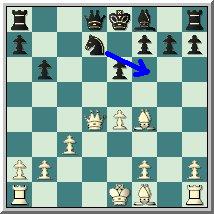
1980 Games
[Event "WCC Championship"]
[Site "St. Joseph Club, Cleghorn, Fitchburg, MA"]
[Date "1980.07.20"]
[Round "9"]
[White "Bryant Hopkins III"]
[Black "George Mirijanian"]
[Result "0-1"]
[ECO "B00"]
[Opening "Alekhine's Defense, Modern Variation"]
[WhiteElo "1626"]
[BlackElo "1860"]
[PlyCount "54"]
[Moves "27"]
[Board "1"]
[TimeControl "40/90"]
[Annotations "George Mirijanian"]
Central New England Open Games
From 1961 until 19xx, the WCC organized promoted & sponsored an annual USCF rated chess tournament called The Central New England Open. It was eventually divided into an open section & one or more class sections, but initially I believe it consisted of one large open section only with some prizes given for best score below certain rating criteria, much like the US Open still is today. Early CNEO Tournaments had secondary & tertiary time controls & typical primary time controls were 50 moves in two or two & a half hours, which could result in adjournments &/or delays. By 1971 & probably before that, the tournament was split into three sections, "open", "reserve", & "booster". There were class prizes within each section for best performance under a certain rating. The time control in 1986 was "45 moves in 2 hours, followed by 20 moves in one hour". I believe there were no "sudden death" time control provisions, which meant that after 60 moves had been made, each player would have an additional hour to make another 20 moves & that process would repeat indefinitely as needed to finish the game.
| Central New England Open Tournament Statistics | |||||
|---|---|---|---|---|---|
| Number | Year | Dates | Location | Players | Winner |
| 1st | 1961 | VFW Hall, Fitchburg | 16 | (John Curdo)? | |
| 2nd | 1962 | VFW Hall, Fitchburg | David Lees | ||
| 3rd | 1963 | June 22 & 23 | VFW Hall, Fitchburg | (David Lees & John Ducharme jr.)? | |
| 4th | 1964 | June 27 & 28 | First Parish Church Hall, Fitchburg | 82 | William Addison |
| 5th | 1965 | June 26 & 27 | Hotel Raymond, Fitchburg | ||
| 6th | 1966 | Hotel Raymond, Fitchburg | |||
| 7th | 1967 | John Curdo | |||
| 8th | 1968 | July 13 & 14 | YMCA, Fitchburg | ,= | John Curdo & Camille Coudari of Montreal |
| 11th | 1971 | June ?? & ?? | Holiday Inn, Leominster | 33, 30, 66 = 129 | Bruce Amos & Ian Hambleton; Mirijanian 1st Class A |
| 12th | 1972 | ??; Stephen Brudno, Jon Edwards | |||
| 16th | 1976 | June 19 & 20 | Holiday Inn, Leominster | 28,14,24,36,30=132 | Champ: John Curdo, 16-yr-old Girome Bono, & GM Leonid Shamkovich Am: Walter Trice, John Sylvia, & Joel Johnson |
| 17th | 1977 | June 11 &12 | Holiday Inn, Leominster | 5rd, 5sec | |
| 21st | 1981 | May 23, 24, & 25 | Holiday Inn, Leominster | ||
| 26th | 1986 | May 24, 25, & 26 | Holiday Inn, Leominster |
Here's a rather interesting game from the 1986 Central New England Open, in which [I believe 11 year old at the time] Robert (Bobby) Seltzer competes in the Class A section & loses his first round game to 1939 rated Tony Jones. Within five years of this game Bobby's USCF rating peaked at 2336.
{Game #209}
Tom Wiedeman Games
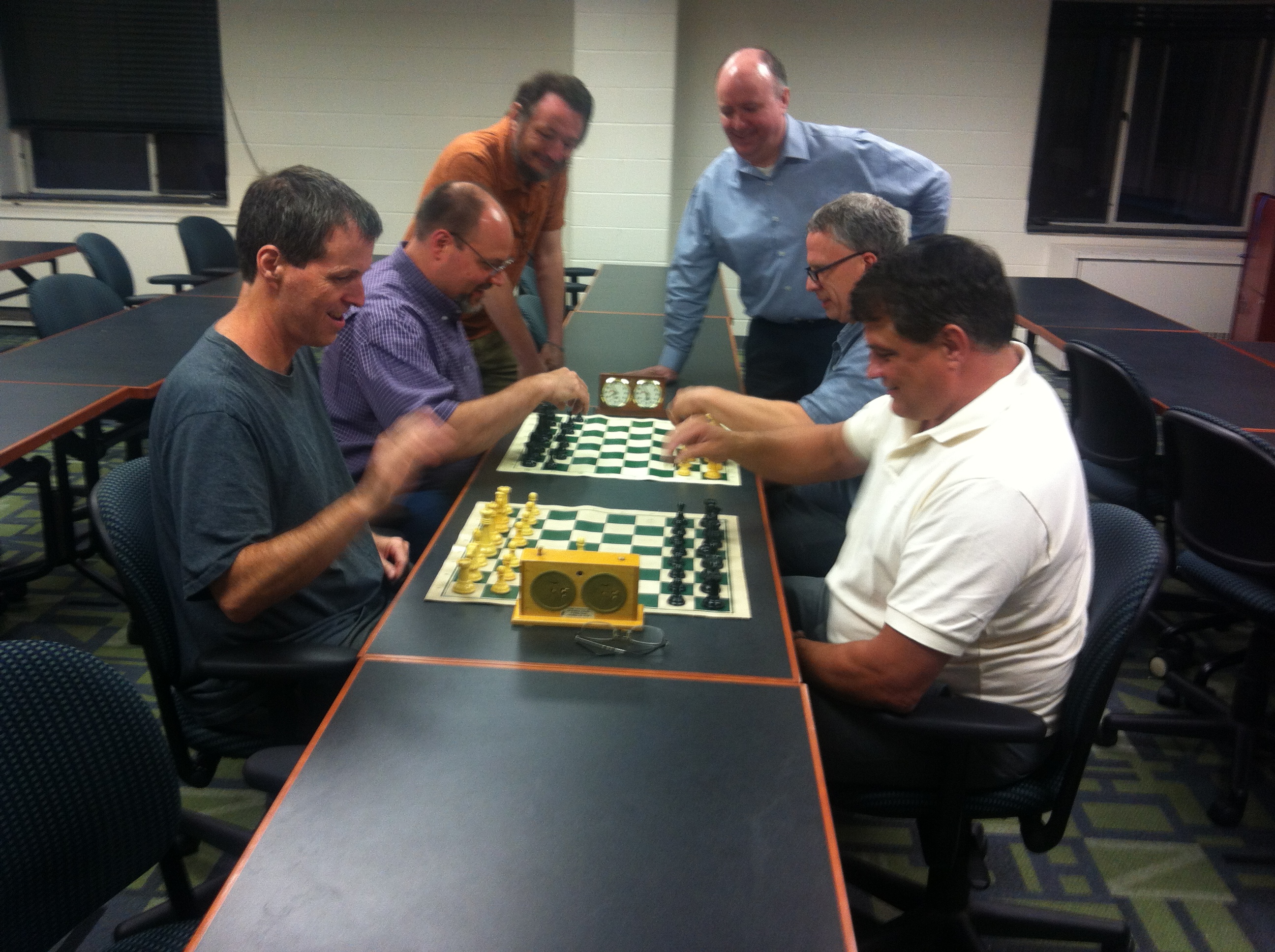
Tom Weideman, front left, on a recent visit to the WCC
These games may be found on Tom Weideman's online blog at: http://fizzycyst.livejournal.com/?tag=chess
Memorable chess games
After a long hiatus from this blog, I found I wanted to share some chess games with a number of people. I didn't want to foist these upon them by email, so I decided to blog them and point here for optional reading. I basically wanted to get these games and their related anecdotes written down somewhere for myself (and possibly my kids someday), while giving other people who might find them interesting a chance to read them without shoving them down anyone's throat.
Each game will get its own separate entry, complete with back story and a small amount of analysis. Warning about the latter: I will on occasion use a computer to analyze positions, but I won't always, and therefore do not guarantee the accuracy of the assessments I reach. The point is that some of the analysis is "artistic", in that it does not delve into every variation and subvariation that can follow, but rather points out interesting aspects of the position, some of which may be nearly irrelevant to determining proper play.
Finally, I want to point out that my most memorable games are not generally my best-played games. They can be classified as "memorable" entirely because of the back story, or because it featured a spectacular finish (though often gratuitously-so), or any number of other reasons. If I remember, I will attempt to give you my playing strength at the time of the game, so that you can put the quality of my play into the proper context, but keep in mind that these entries aren't really a sampling to demonstrate how well I played. They are, as they say, "for entertainment purposes only".
With all that said, I give you my chess memoirs. Enjoy.
I am going to attempt to enter these games in chronological order, and my first game comes from my very first USCF-rated event (and I think only my third tournament of any kind, the other two being unrated scholastic events). I came into the 21-player open tournament ranked 21st, and somehow managed to win my first three games. My final round pairing was a very large step upward from those, however: My 4th round opponent Stephen Ducharme was rated 1653 - more than 200 Elo points higher than my toughest opponent from the first 3 rounds. He was one of two superstar high school players (a recent graduate at the time) from our county scholastic league. This first board from a cross-town rival team is not expected to have much trouble with an alternate from a team whose first board was rated around 1200. But I played well above expectation that day, and I suspect he played well below, so we had a perfect storm.
White: Weideman, Tom
Black: Ducharme, Stephen
Event: Pequoig CC August Open (4)
Round: 4
Date: 1977.08.27
ECO: [A57]
Opening: Benko Gambit
1 d4 Nf6 2 c4 c5 3 d5 b5
{I'm pretty sure I had never seen this before in my life at that point, so I wasn't about to mess around with accepting the gambit.}
4 e3 d6 5 b3 g6 6 Nf3 Bg7 7 Bb2 bxc4 8 Bxc4
{Not the prettiest white position I've ever seen, but at least he is not killing me with a line that he knew inside-out that I had no clue about.}
8... Bb7 9 Nbd2 O-O 10 e4 Nbd7 11 O-O Nb6 12 Re1 a5 13 a4 Qc7 14 Qe2 Nbd7 15 Bb5 Nb8 16 Nc4 Na6
{At this point, my computer rates white as slightly better. That's about to change as my aggressive nature gets the better of me (a common theme throughout my chess career, btw).}
17 e5? Nxd5 18 exd6 exd6 19 Bxg7 Kxg7
{Despite the blunder of the pawn, the evaluation of the position now is only very slightly worse for white, meaning my position has some compensation for the material.}
20 Ne3 Nc3?
{A terrible move. Even a newbie like me could find the right play here.}
21 Qb2 d5
{If his plan was to fork the knight and queen with the pawn to recover the piece, it was faulty in more ways than one. I could simply take the knight and retreat the Q to b2 (keeping the pawn pinned), or...}
22 Bxa6 Rxa6 23 Qxc3+ d4?
{As stated above, this doesn't work at all. Clearly Steve was having a bad day.}
24 Nxd4 Kg8
{Now white is a full piece up and should win easily. What follows characterizes my play in the early years perfectly - gratuitous tactics. I typically did a pretty good job of finding "brilliant" moves when it was completely unnecessary. But to be fair to myself, I should say that Ducharme was a considerably stronger player than me, and the "safe" approach could have ended with him finding resources, considering all the major pieces are still on the board. Keeping him on his heels with a riskier play might have actually been better from a practical perspective.}
25 Ndf5!?
{The computer gives 25 Nef5 as the best move. The reason they are different is, of course, that black doesn't have to take the knight. But if he doesn't, then I'm not giving back the knight, and my move was not dubious after all! It turns out that he does in fact take it, and that makes my move essentially equivalent to the computer's move. Good thing, because judging from the rather weak technique I displayed in finishing-off the game, I needed all the cushion I could get.}
25... gxf5 26 Nxf5 Rg6 27 Ne7+ Qxe7 28 Rxe7 Rxg2+ 29 Kf1 Ba8 30 Rae1 Rg6 31 f3 Bc6 32 Qxc5 Rd8 33 Qf5 Rf8 34 Qxa5 Rf6 35 Qg5+ Rg6 36 Qh5 Rf6 37 R1e3 Rd8 38 Qg5+ Rg6 39 Qf5 Rf8 40 h4 h6 41 Rxf7 Rxf7 42 Qxg6+ Rg7 43 Qxc6 Kh7 44 Re6 Rf7 45 Rxh6+ Kg7 46 Qg6+ Kf8 47 Rh7 Rxf3+ 48 Ke2 Rf2+
{For a brief moment, my heart sank. I was aware of stalemate swindles, even at this tender age, and I was not immediately certain I could escape the checks. Nowadays I wouldn't even need to calculate it out to know that escaping this is easy}
49 Ke3 Rf3+ 50 Kd4 Rf4+ 51 Qe4
{Heh, funny that I didn't select simply 51 Ke5.}
51... Kg8 52 Qxf4 Kxh7 53 Qg5 1-0
{I went to this tournament with someone who was at the time a new friend (and is now one of my oldest friends), Frank Everett. When my dad arrived in the middle of this game to pick me up (I was 15 - too young to drive), Frank told him that I was on the verge of sweeping the tournament. I think my Dad was as stunned as everyone else there, even though he witnessed first hand my 10-month-long obsession with the game, where I pored over library books, played games with friends over the phone, and even played against myself for hours.}
{The entry fee was $5, and the first prize of $25 felt like a small fortune to me. I won many tournaments in the years to follow, but none of them ever felt quite as good as this one.}
Billl Addison Games
"The following selection includes two of Addison's games against Fischer, and wins against some of the top American players of his day such as Lombardy and Reshevsky. When going over Addison's games this morning, I was taken by the excitement of many of his contests, and I urge readers to seek out more." -Jennifer Shahade
USA, 1955 [D10]
White: Steiner,Herman
Black: Addison,William
1.c4 c6 2.d4 d5 3.Nd2 Nf6 4.Ngf3 Bf5 5.Qb3 Qb6 6.c5 Qc7 7.Nh4 Bg6 8.a3 e5 9.dxe5 Nfd7 10.Nxg6 hxg6 11.e6 fxe6 12.Qc2 Kf7 13.Nf3 Be7 14.b4 a5 15.Rb1 axb4 16.axb4 Ne5 17.Rb3 Ra1 18.Qb2 Bf6 19.Nd4 Ra4 20.Qc2 Na6 21.Rh3 Rxh3 22.Qxa4 Rc3 23.Bd2 Nxc5 24.bxc5 Rc4 25.Qa2 Rxd4 26.e3 Rh4 27.g3 Rxh2 28.Rxh2 Nf3+ 29.Ke2 Nxh2 30.Bh3 g5
31.f4 g4 32.Bg2 b6 33.Qb1 bxc5 34.Qh7 Qb7 35.Qxh2 Qb5+ 36.Ke1 Qb1+ 37.Ke2 c4 38.Qh1 Qd3+ 39.Ke1 c3 40.Bc1 Qc2 41.Ba3 Qb1+ 0-1
U.S. Open, 1957, Cleveland OH, [B10]
White: Fischer, Robert James
Black: Addison, William
1.e4 c6 2.Nc3 d5 3.Nf3 dxe4 4.Nxe4 Nf6 5.Nxf6+ exf6 6.Bc4 Bd6 7.Qe2+ Qe7 8.Qxe7+ Kxe7 9.d4 Bf5 10.Bb3 Re8 11.Be3 Kf8 12.O-O-O Nd7 13.c4 Rad8 14.Bc2 Bxc2 15.Kxc2 f5 16.Rhe1 f4 17.Bd2 Nf6 18.Ne5 g5 19.f3 Nh5 20.Ng4 Kg7 21.Bc3 Kg6 22.Rxe8 Rxe8 23.c5 Bb8 24.d5 cxd5 25.Rxd5 f5 26.Ne5+ Bxe5 27.Rxe5 Nf6 28.Rxe8 Nxe8 29.Be5 Kh5 30.Kd3 g4 31.b4 a6 32.a4 gxf3 33.gxf3 Kh4 34.b5 axb5 35.a5 Kh3 36.c6 1-0
U.S. Championship/Rosenwald New York City, NY (8), 1962 [E66]
White: Addison, William
Black: Mednis,Edmar
1.d4 Nf6 2.c4 g6 3.g3 Bg7 4.Bg2 0-0 5.Nc3 d6 6.Nf3 Nc6 7.0-0 a6 8.d5 Na5 9.Nd2 c5 10.Qc2 Rb8 11.b3 b5 12.Bb2 Bd7 13.Rfb1 Qc7 14.Nce4 Nxe4 15.Bxe4 Bxb2 16.Rxb2 bxc4 17.bxc4 Rxb2 18.Qxb2 Rb8 19.Qc3 Rb4 20.a3 Rb7 21.h4 h5 22.Bc2 Qb6 23.Rb1 Qd8 24.Re1 Qb6 25.Bd3 Qd8 26.f4 Bg4 27.Rf1 Qb6 28.f5 gxf5 29.Bxf5 Bxf5 30.Rxf5 f6
31.Rxh5 Kf8 32.Qd3 Ke8 33.Rh8+ 1-0
U.S. Championship, New York, 1962
White: Addison, William
Black: Reshevsky, Samuel Herman
1.d4 Nf6 2.c4 g6 3.g3 Bg7 4.Bg2 O-O 5.Nc3 d6 6.Nf3 Nbd7 7.O-O e5 8.e4 c6 9.h3 exd4 10.Nxd4 Re8 11.Be3 a5 12.Qc2 Nc5 13.Rad1 Nfd7 14.Nb3 Qe7 15.Nxc5 Nxc5 16.Qd2 Bf8 17.Rfe1 Be6 18.Nd5 cxd5 19.exd5 Ne4 20.Bxe4 Bxh3 21.Bd4 Qc7 22.Qc3 Rac8 23.Bd3 a4 24.Rxe8 Rxe8 25.Re1 Rxe1+ 26.Qxe1 Qd7 27.b4 axb3 28.axb3 Qg4 29.Qe3 Qd1+ 30.Kh2 Bg4 31.Be4 Bh6 32.Qc3 Bd2 33.Qb2 h5 34.Qa3 Bh6 35.Qa8+ Bf8 36.Be3 Bf3 37.Bxf3 Qxf3 38.Kg1 h4 39.Bh6 1-0
U.S. Championship/Rosenwald New York City, NY (10), 1962 [D29]
White: Addison, William
Black: Berliner,Hans
1.d4 d5 2.c4 dxc4 3.Nf3 Nf6 4.e3 e6 5.Bxc4 c5 6.0-0 a6 7.Qe2 b5 8.Bb3 Bb7 9.Rd1 Nbd7 10.Nc3 Qc7 11.e4 b4
12.Nd5 exd5 13.exd5+ Be7 14.dxc5 Nxd5 15.Bxd5 Bxd5 16.Rxd5 Nxc5 17.Be3 Nd7 18.Bg5 f6 19.Re1 Nb6 20.Bf4 Qb7 21.Rc5 Rc8 22.Bd6 Rxc5 23.Qxe7+ 1-0
U.S. Championship, Closed New York City NY, 1963 [E60]
White: Addison, William
Black: Byrne,Donald
1.d4 Nf6 2.c4 g6 3.g3 c5 4.d5 d6 5.Nc3 Bg7 6.Bg2 a6 7.a4 0-0 8.e4 e5 9.h4 Nbd7 10.Bh3 Rb8 11.Nf3 Nb6 12.Bxc8 Qxc8 13.b3 Na8 14.Bg5 h6 15.Bxf6 Bxf6 16.a5 g5
17.Nh2 Bd8 18.h5 Nc7 19.Ng4 Kh7 20.Ne3 Ne8 21.g4 Bc7 22.Ra3 Qd8 23.Qa1 Ng7 24.Ke2 Qc8 25.Qa2 b6 26.axb6 Rxb6 27.Ra1 Qb7 28.Rxa6 Rxa6 29.Qxa6 Qxb3 30.Qa3 Qb8
31.Rb1 Qd8 32.Rb5 Qe7 33.Qa7 Rc8 34.Rb8 Qd8 35.Qa6 Kg8 36.Rb5 Bb8 37.Qb6 Qxb6 38.Rxb6 Rd8 39.f3 Kf8 40.Rb7 Kg8 41.Kd3 Kf8 42.Kc2 Kg8 43.Kb3 Kf8 44.Ka4 Kg8
45.Ka5 Kf8 46.Ka6 Ke8 1-0
Stamer Memorial, San Francisco CA (5), 1964 [A00]
White: Suttles,Duncan
Black: Addison,William
1.g3 Nf6 2.Bg2 d5 3.d3 c6 4.Nc3 e5 5.e4 Bb4 6.Bd2 d4 7.Nce2 Bxd2+ 8.Qxd2 Qe7 9.f3 c5 10.Nh3 Nc6 11.Nf2 Rb8 12.0-0 0-0 13.f4 Ng4 14.Nxg4 Bxg4 15.Rae1 b5 16.h3 Bxe2
17.Rxe2 c4 18.Kh2 Qc5 19.b3 Rfd8 20.Ref2 Rb6 21.h4 h6 22.f5 f6 23.g4 Kf7 24.g5 hxg5 25.hxg5 Rh8+ 26.Kg3 Rbb8 27.Bf3 Qb4 28.Qe2 fxg5 29.Bh5+ Kf6 30.Rg2 Rh6
31.Qg4 Rbh8 32.Rh1 cxd3 33.Kf3 Ke7 34.Qxg5+ Kd6 35.Qxg7 Kc5 36.Rg6 Qd2 37.b4+ Kb6 38.Qxe5 Qe3+ 39.Kg2 Rxg6+ 40.Bxg6 Nxe5 41.Rxh8 Qf3+ 0-1
1965 U.S. Championship, New York City NY (1), [E45]
White: Addison,William
Black: Fischer,Robert
1.d4 Nf6 2.c4 e6 3.Nc3 Bb4 4.e3 b6 5.Nge2 Ba6 6.a3 Bxc3+ 7.Nxc3 d5 8.b3 0-0 9.a4 Nc6 10.Bb2 dxc4 11.bxc4 Na5 12.Nb5 c6 13.Na3 Qe7 14.Qc2 c5 15.Be2 cxd4 16.exd4 Rfc8
17.0-0 Rc6 18.Bf3 Nd5 19.Bxd5 exd5 20.Rfe1 Qf8 21.Qf5 dxc4 22.d5 Rg6 23.Nc2 Nb3 24.Ba3 Qd8 25.Be7 Qc8 26.Qxc8+ Bxc8 27.Ra3 Bd7 28.Ne3 Nd4 29.Rd1 Nf5 30.Nxf5 Bxf5 31.d6 Bd7 32.Rc1 Rg4 33.f3 Rd4 34.Kf2 Rc8 35.Rac3 f6 36.Ke3 Rh4 37.g3 Rxh2 38.Rxc4 Rxc4 39.Rxc4 Kf7 40.Rc7 Ke6 41.Rxa7 Rb2 42.f4 Rb3+ 43.Kf2 f5 44.g4 g6
45.gxf5+ gxf5 46.a5 b5 47.a6 Rb4 48.Kg3 Ra4 49.Bf8 h5 50.Be7 Bc6 51.Bf8 h4+ 52.Kh3 Bd7 53.Bh6 Kxd6 54.Kxh4 Bc8 55.Kg5 Bxa6 56.Ra8 Kc7 57.Bg7 b4 58.Be5+ Kd7 59.Kf6 1/2-1/2
1965 U.S. Championship, Closed New York City NY (5) [A48]
White: Bisguier,Arthur
Black: Addison,William
1.d4 Nf6 2.Nf3 g6 3.Bg5 Bg7 4.Nbd2 c5 5.c3 cxd4 6.cxd4 Nc6 7.e3 0-0 8.a3 h6 9.Bh4 d6 10.Bc4 Bf5 11.h3 Rc8 12.0-0 e5 13.e4 Bd7 14.dxe5 dxe5 15.Ba2 g5
16.Bg3 Qe7 17.Re1 Rcd8 18.Nh2 Be6 19.Bxe6 Qxe6 20.Nhf1 Rd3 21.Re3 Rd7 22.Qb3 Qe7 23.Nf3 Rfd8 24.Rae1 Nh5 25.Rc3 Qf6 26.Ne3 Nd4 27.Nxd4 exd4 28.Ng4 Qg6 29.Rd3 Nxg3 30.fxg3 Rc7 31.Nf2 Rdc8 32.Re2 Rc1+ 33.Kh2 h5 34.Qxb7 Be5 35.Qd5 R1c5 36.Qd7 h4 37.Nh1 Rc1 38.Rf3 g4 39.Qxg4 Qxg4 40.hxg4 Kg7 41.Rf5 Rxh1+ 0-1
1966 U.S. Championship
White: Fischer, Robert James
Black: Addison, William
1.e4 e5 2.Nf3 Nc6 3.Bb5 a6 4.Ba4 Nf6 5.O-O Nxe4 6.d4 b5 7.Bb3 d5 8.Nxe5 Nxe5 9.dxe5 c6 10.Be3 Be7 11.Nd2 Nxd2 12.Qxd2 O-O 13.Qc3 Bb7 14.f4 a5 15.a3 b4 16.Qd2 a4 17.Ba2 bxa3 18.bxa3 Bxa3 19.Rfb1 Bc8 20.Bxd5 Qxd5 21.Rxa3 Qxd2 22.Bxd2 Bf5 23.Rb2 Rfd8 24.Be3 h5 25.h3 Rdb8 26.Rxb8+ Rxb8 27.Rxa4 Bxc2 28.Rc4 Rb1+ 29.Kf2 Rb2 30.Kg3 Bf5 31.Rxc6 Rxg2+ 1/2-1/2
U.S. Championship, 1969, New York
White: Addison, William
Black: Lombardy, William James
1.d4 Nf6 2.c4 g6 3.Nc3 Bg7 4.e4 d6 5.Nf3 O-O 6.Be2 e5 7.O-O Nbd7 8.Re1 c6 9.Bf1 Qe7 10.Rb1 Ne8 11.b3 Nc7 12.Ba3 Ne6 13.Ne2 exd4 14.Nfxd4 Nxd4 15.Nxd4 a5 16.Qd2 Nc5 17.Rbd1 Re8 18.Nc2 a4 19.b4 Nxe4 20.Rxe4 Qxe4 21.Re1 Qxe1 22.Nxe1 Bf5 23.Nf3 Be4 24.Ng5 Bf5 25.h3 h6 26.g4 Bb1 27.Nf3 d5 28.Bd3 Bxd3 29.Qxd3 Rad8 30.b5 Re6 31.bxc6 Rxc6 32.c5 d4 33.Qb5 d3 34.Qxb7 Rf6 35.c6 d2 36.Nxd2 Rxd2 37.Bc5 Rc2 38.Qb8+ Kh7 39.Qb5 Rf4 40.c7 Bd4 41.Bxd4 Rxd4 42.Qb7 Rdc4 43.c8=Q Rxc8 44.Qxf7+ Kh8 45.Qf6+ Kh7 46.Qf7+ Kh8 47.Qxg6 R8c6 48.Qe8+ Kg7 49.Qe7+ Kg8 50.Qd8+ Kg7 51.Qd4+ Rf6 52.h4 Kf7 53.Qxa4 Rfc6 54.Qf4+ Ke7 55.Qe4+ Kd7 56.a4 R2c4 57.Qf5+ Kc7 58.a5 Kb7 59.Kg2 Ka6 60.g5 hxg5 61.hxg5 R6c5 62.Qf6+ Kxa5 63.Kg3 Rc1 64.f4 Kb5 65.Qb2+ Kc6 66.Kg4 Kd7 67.Kh5 Rc6 68.Qg7+ Ke8 69.Qg8+ Ke7 70.Qh7+ Kf8 71.Qe4 R1c4 72.Qd5 Kg7 73.Qd7+ Kf8 74.f5 Rc8 75.f6 R4c7 76.Qd6+ Kg8 77.g6 Kh8 78.Kh6 Rc6 79.g7+ Kg8 80.Qd5+ Re6 81.Qxe6# 1-0
Palma De Mallorca Interzonal (1), 1970 [D16]
White: Taimanov,Mark
Black: Addison,William
1.c4 c6 2.d4 d5 3.Nf3 Nf6 4.Nc3 dxc4 5.a4 Na6 6.e4 Bg4
7.Bxc4 e6 8.0-0 Nb4 9.Be3 Be7 10.Be2 0-0 11.Ne5 Bxe2
12.Qxe2 c5 13.Rfd1 cxd4 14.Bxd4 Qb8 15.Nc4 Nc6 16.e5
Nd5 17.Nxd5 exd5 18.Na3 Re8 19.e6 Qf4 20.Nb5 Rac8
21.Bxa7 Nxa7 22.Nxa7 Rcd8 23.Nb5 Bc5 24.Qc2 b6 25.g3
Qf6 26.Nc7 Rf8 27.b4 Bxb4 28.Rab1 Bc5 29.Nxd5 Qxe6
1/2-1/2
Palma De Mallorca Interzonal, 1970
White: Addison, William
Black: Gligoric, Svetozar
1.d4 Nf6 2.c4 g6 3.g3 Bg7 4.Bg2 O-O 5.Nc3 d6 6.Nf3 Nc6 7.O-O e5 8.d5 Ne7 9.e4 Ne8 10.Nh4 c5 11.dxc6 Nxc6 12.h3 Nc7 13.Nf3 Ne6 14.Nb5 Ned4 15.Nbxd4 exd4 16.b3 Re8 17.Re1 Qb6 18.Bb2 a5 19.a4 Bd7 20.Rb1 Re7 21.Ba3 Nb4 22.Qd2 Rae8 23.Bxb4 axb4 24.Rbd1 Qc5 25.Nxd4 f5 26.Qd3 fxe4 27.Rxe4 Rxe4 28.Bxe4 Bxh3 29.Nb5 Kh8 30.Qd5 Rf8 31.Qxc5 dxc5 32.Bxb7 Bf5 33.a5 Bc2 34.Rc1 Bxb3 35.a6 Ba2 36.a7 b3 37.Rf1 b2 38.Na3 Bc3 39.a8=Q Rxa8 40.Bxa8 Bb4 41.Nb1 Bxc4 42.Rd1 Be6 43.Be4 Kg7 44.Rd6 1-0
Allan Bennett Games
As five time WCC Champion, I'm sure Allan Bennett produced some fine examples of chess during his years at the club. At this point in time not one of those game scores is available, so I'll post a few of what I consider interesting or instructional games Allan played in various events at other locations.
At some point I'll publish some detailed notes about this game. Suffice it to say that, any time you can play up nearly 400 rating points & come away with a full point from three time US Champ, GM Larry Christiansen, you've played well! Here Allan does exactly that employing precisely the style which made his famous foe famous, a stellar accomplishment indeed.
In this game, Allan opens with 1. e4 & Justin plays a fairly standard Center Counter Defense through some typical positions with of course tactical complications. After some tense double edged maneuvers, Allan eventually saves a pawn-down queen ending by swapping queens & using fine endgame technique whittling both himself & Justin down to bare kings to split the point.
John Grefe Games
IM John Grefe US Co-Champ 1973
Here is his decisive win over Walter Browne, later a six-time winner of the U.S. Championship himself, in the 1973 championship:
Grefe versus Browne, U.S. Championship 1973[4]
1. e4 c5 2. Nf3 d6 3. d4 cxd4 4. Nxd4 Nf6 5. Nc3 a6 6. Bg5 e6 7. f4 Be7 8. Qf3 h6 9. Bh4 Qc7 10. 0-0-0 Nbd7 11. Be2 Rb8 12. Qg3 Rg8 13. Rhf1 g5 14. fxg5 Ne5 15. Nf3 b5 16. Nxe5 b4 17. Nxf7 bxc3 18. gxf6 Rxg3 19. fxe7 Rg5 20. Bxg5 hxg5 21. Nxd6+ 1-0
Here is a brilliancy against veteran grandmaster Miguel Najdorf:
Grefe versus Najdorf, Lone Pine 1976[5]
1. e4 e5 2. Nf3 d6 3. d4 Nf6 4. Nc3 Nbd7 5. Bc4 Be7 6. 0-0 0-0 7. Qe2 c6 8. a4 Qc7 9. h3 exd4 10. Nxd4 Re8 11. Bf4 Ne5 12. Bb3 Nfd7 13. Rad1 Bf8 14. Bc1 Nc5 15. Ba2 d5 16. f4 Ned7 17. e5 Nb6 18. a5 Nbd7 19. Qh5 Ne6 20. Nf5 Qxa5 21. Rf3 Nb6 22. Rg3 g6 23. Qh4 Na4 24. Rxd5!? Qb6+ On 25...cxd5, Shredder analyzes 26.Nxd5 Bg7 27.Nxg7 Kxg7 28.Nf6 h5 29.f5 Rh8 30.Nd7! Bxd7 31.Qf6+ Kg8 32.Kh2 followed by Rxg6+ or fxg6. 25. Be3 Qb4? Rybka considers the queen sacrifice 25...Nxc3! 26.Bxb6 Ne2+ 27.Kh2 axb6 favorable to Black. 26. Rb5! Nxc3 27. Rxb4 Ne2+ 28. Kh2 Nxg3 29. Qxg3 Bxb4 30. Nh6+ Kh8 31. f5! Nd8 32. fxg6 fxg6 33. Qf4 Bf8 34. Nf7+ Nxf7 35. Qxf7 Be6 36. Bxe6 Bg7 37. Bd4 Rad8 38. Bc3 b5 39. Bd7 Rf8 40. Qe7 1-0 (Analysis from chessgames.com)
Milan Vukcevich Games

Bobby Fischer is the most famous & arguably the strongest player ever to visit any WCC event, however he certainly was not the only world class player to do so.
Milan Rodoje Vukcevich competed in the 1964 Central new England Open held by the WCC in Fitchburg MA at the First Parish Church Hall on main Street. This was a five round tournament & I have none of Vukcevich's games from that tournament. However, his chess career spanned from at least 1955 to 1981 & included such noteworthy opponents as: Arthur Bisguier, Walter Browne, John Curdo, Svetosar Gligoric, Bukhuti Gurgenidze, John Grefe, William Martz, William Lombardy, Miguel Najdorf, Vasily Panov, jack Peters, Tigran Petrosian, Ken Rogoff, Leonid Shamkovich, Yasir Sierawan, Vasilly Smyslov, Jan Timman,
Probably one of the most explosive games one could imagine betweeen a couple of top notch players then or now occurred in 1955 between Milan Vukcevich & Vasilly Panov. The game is a classical French Defense, MacCutcheon Variation mineature wherein Vukcevich presents Panov with a two rook sacrifice. Panov takes one rook & sees that if he takes the second rook, he gets mated nine moves later, so he refuses to bite whereuopn Vukcevich immediately offers the second rook again! This time Panov, either thinking it's now safe or out of sheer exasperation, accepts the bait & proceeds to get mated eight moves later!